In 2017, I went to Vienna.
I’m more than aware of how fortunate I am to be able to travel, every once in a while. Traveling is an amazing way of learning and growing, and it is a privilege that I have the possibility of doing so. I love traveling. I truly feel the meaning of the expression Citizen of the World. The world was here long before humans were. If humans suddenly disappear, it will likely go on perfectly well without us. The opportunity of being alive in this beautiful, extraordinary planet is one I treasure, and to be able to explore it, not just in its natural beauties, but also in the works of the people who came before us, is just… but enough of this elegy. I’m here to tell you a story. The story of my trip to Vienna.
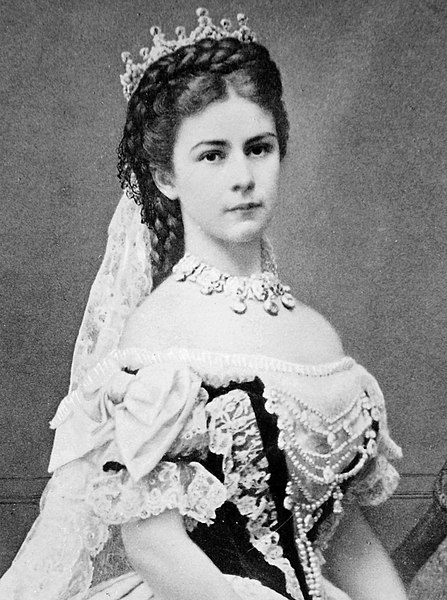
Why Vienna? I, just as many other people who grew up in the 90s, had a blissful and easy access to cartoons. We had it all, from the older Tom & Jerry sketches to classical Disney, Don Bluth and even 20th Century Fox. There were larger companies and smaller companies, of course, which made more or less successful cartoons, usually either shown on TV channels for kids or in direct-to-VHS releases. One of those cartoons was Sissi. This is a 1997 Canadian cartoon which loosely follows the life of Empress Elisabeth of Austria in her early years. She is presented to us as a joyful blonde girl, blue-eyed and slender, with lovely and colourful dresses and a very pleasant family life. I don’t know how popular this cartoon was in Canada. Where I grew up, it achieved decent popularity, to an extent that Sissi dolls were made and sold, and I was the proud owner of a Sissi with a pretty mint-green dress. I did not know, of course, that there was an actual historical person on which the cartoon was based, at that tender age. Funnily enough, I have absolutely no idea how I found Sissi again. Perhaps I was looking for this cartoon. I know I was in my teens, during a period in which I was very deeply set into learning all I could about the 19th century (well, some things never change), when my love for crinolines was born. Yes, perhaps that was it. Perhaps I accidentally found Sissi on Wikipedia when looking for crinolines. All I know is that I ran into that very famous picture of her, the one you can see below, and was drawn to that image of a beautiful woman with glorious hair and a beautiful gown, a bit like a fairy-tale.
I ran into historical Sissi, and it did not take long for me to see how much the cartoon had distorted her reality for our childish minds, to a point of making Helena, her sister, into a rival, to a point of completely altering her physical appearance, to a point of making Elisabeth into a Disney-like Sissi. And I’m not saying this is wrong. Sissi-the-cartoon was absolutely adorable, I would easily re-watch it, it was part of my childhood and I wouldn’t change a thing. But changing Sissi into something else seems a big deal with all the adaptations that touch her life. There’s been a second cartoon, which I have not watched, but that has given Sissi auburn, flowing locks and blue eyes yet again (what is it against brown-eyed princesses?! Us brown-eyed people want princesses to accurately cosplay without lenses too, you know! Ha). Then, there’s the Sissi trilogy, which I watched a little later on. I enjoyed it immensely – Romy Schneider was adorably sweet as Sissi, the storyline was tender and charming. A bit like Sound of Music. But there is very little of the real Sissi in Romy Schneider’s trilogy, especially as the films are trying to adapt her early years, and character’s style and personality match them little to nothing. A few years later, we got the version with Cristiana Capotondi – a huge improvement in accuracy, if you ask me, but still very distant from a historical Sissi.
Now, I know these are not meant to be documentaries. I know! Don’t get mad at me. I loved each adaptation individually for what it was. All I am saying is that I would greatly enjoy a historically accurate adaptation of Elisabeth, one that would truly allow one to understand her as a person, which is something I sense she sorely lacked in waking life. Not too many people cared for Elisabeth and truly liked her as a person. As much as these adaptations are adorable – and, I will say, even necessary, because we all need something sweet to lighten our mood, on occasion – they don’t do that job, so dear to a Historian, of bringing one closer to the historical person. And I’d been seeking the historical person for a while, and even more so as I entered into my 20s. There was something fascinating about her, her whole life, her story, her sadness, her family, the real woman behind the myth, something which is hard to find still without having access to her writings, her letters (even harder when you’re like me and you don’t speak German nor Hungarian). But I kept on looking. This coincided with the advent of Pinterest, so I got plenty of photographic information about her. I have a folder dedicated exclusively to Empress Elisabeth, and I must have seen every single photo of her which is available on-line – I have the strong belief that many photos and paintings still won’t be within our access, as is often the case. Then, I got Brigitte Hamann’s The Reluctant Empress, which has very precious information about Elisabeth’s life. Then, I found out there was a Sissi Museum in Vienna. Then… well, I could stick with the how and the then for a long while, but it is clear to see that one thing led to another, and at some point after realising there were places where I could be in contact with her History, I really, really wanted to go. Therefore, I was absolutely spoiled and got that trip to Vienna as a Christmas present, I booked it, and I went.
Sometime in March, I was landing in Vienna for the very first time. It was not exactly what I expected. Actually, I don’t know what I expected. But I’d only ever visited very large capital cities, and Vienna isn’t like that at all. Vienna is a smaller city, surrounded by mountains and filled with 19th century architecture. Needless to say, I was enchanted. I stayed in a very pleasant hotel close to the Danube, and the very first thing I did upon arrival – well, after dropping my bags in the bedroom – was to go on a quest for the Augustinerkirche and the Capuchin crypts. It did not take me long, fortunately. With some patience and a GPS, reaching places in Vienna is fairly quick. So I reached the Augustinerkirche and I was very surprised. Elisabeth married the Emperor of Austria, Franz Joseph, on the 24th April 1854, inside that very same church. And it was tiny! I was expecting a large cathedral, or something small but imponent, but there was nothing within that church to say that emperors had married there. It was tradition, it seemed, and it is a very old church, founded in the 14th century, and undoubtedly pretty, but I never expected Elisabeth to have married an emperor inside a church that seems almost lost and undiscernible amidst many other buildings. I trailed the path she must have trailed, nearly one-hundred years ago, when a young girl born Herzogin in Bayern (a Duchess in Bavaria), became Empress Elisabeth Amalie Eugenie of Austria, consort to Franz Joseph, the Emperor. It was an interesting experience and a touching one as well – while everyone was off and about taking photos (and not too many people were inside), I was just… observing. Hearing the sounds, looking at the colours. It was solemn, at least, and I can imagine little Elisabeth, at such a young age, must have felt very lost and that she was entering something very important upon marrying the emperor, something very serious…
After I left the church, and had that sweet little experience, I went on a quest for the crypts, because I knew that was where she is buried. Also not hard to find. The church was already closed, but the crypts themselves were open, and since I was only staying for a few days and was on a budget… off we go. I went in. There are dozens of royals buried there, from infants who passed away in their tenderest years to those who reached old age, young women only married, men in the plenitude of their lives. I even found some names that were well-known to me, which I have entirely forgotten, and I did not take photographs back then. I clearly remember there were Portuguese royals somewhere, and that I reached Elisabeth’s tomb, and there were drawings made by little children and fresh flowers. People still remember her and she still exerts a great deal of fascination. And I remember standing there for a while and thinking: her mortal remains are here, and whatever is left of the woman who once was Elisabeth lies somewhere within this tomb in front of me. The woman who had lived such a restless, unhappy life, the woman who was painted by Winterhalter, who danced in Vienna, who went horse-riding in England, who learned to love Hungary, who travelled to Corfu… well, it is always a humbling experience, to stand in front of a grave of one of those historic personas that became big in our imagination. There she was. Her bones, and whatever clothes she was buried in, and whichever secrets she was carrying to the grave. Beside her was the Emperor – interesting, yes, but it was not him who made me want to go to Vienna. So I respectfully observed his tomb, as I did the tomb of their son, but it was in front of Elisabeth’s that I stood for a longer time.
It is curious how this trip to Vienna started with me looking at her in death, when I went there to try and find her in life. It’s almost a way of going backwards, from the end to the beginning. And even then, hardly the beginning, as Sissi was born and raised in Munich. But she spent a lot more of her life as an Empress than as a Duchess. Sissi, as we know her, was greatly born in Vienna, if I may so say, and unfortunately there is still very little to be known about her early years (if you want to know a little more, you can always go and check out my podcast on the matter, uploaded to my YouTube account. I’ll try and do a post here, eventually). Elisabeth’s life suffered a dramatic change from its relatively sheltered and loose existence in Bavaria when she went to live in Vienna, out of love for an Emperor or out of family pressure – as Hamann says in her book, her mother is quoted as saying something along the lines of “You don’t just send the Emperor of Austria home packing”. Maybe a little bit of both. One could understand how Franz Joseph, a handsome, young and athletic man who loved nature and enjoyed riding may have become interesting to Elisabeth, but one can also understand how a fifteen year-old girl may have been unwilling to give up her youthful peace for adult responsibility at one of the strictest and least inviting European courts. Most people who like Elisabeth already know the story: her sister, Helena, was supposed to be the prospective bride; Franz Joseph fell for Sissi, perhaps because of an infamous black mourning dress; Nene was sent home packing, and suddenly Sissi, a relatively unknown little duchess, was the bride of one of the most powerful men in the world. Franz Joseph seems to me, from all I’ve read, far more certainly in love with Sissi than she was with him, although I do believe that she was fond of him, that she was, perhaps, in love with him, as maturely as a young, sheltered, sensitive and imaginative young woman could have been. But I’d need to read so many more letters, and to know so much more of her early years, to make more decisive points on this matter!
Just the same, the trip continued. Day two was spent at the Hofburg Palace, the one with the Sissi Museum. Throughout this second day, there were a few things I realised about Vienna. Firstly, that the city lives and breathes Sissi. As much as the Viennese court disliked her in life, Vienna is now all about Sissi (and a bit about Mozart). You can get Sissi postcards. Sissi bookmarkers. Sissi books. Sissi stamps. Sissi earrings, necklaces and rings, shaped like the famous stars she wore in her hair. Her image is literally everywhere, and the city itself seems frozen in the 19th century, with its carriages passing by, its forest-mountain-fog-like atmosphere, its stunning beauty, the sound of German names that were already there in her days (Messe-Präter, anyone?). Curiously enough, I don’t remember too much of the Hofburg. There is a curious contrast. The Sissi Museum, which is a small, but very interesting space (you can see several paintings of her, including some of the Winterhalter, and a replica of that beautiful Hungarian Coronation dress, although with the wrong type of Crinoline, if you ask me) has lots of things about her, as is natural, from her tiniest objects to her shoes; but the Hofburg is a lot more Habsburg. You won’t find Elisabeth inside the Hofburg. And yet, when you reach the Museum shop, and although there is plenty of Hofburg merchandise, most of it is Elisabeth merchandise. Archduchess Sophie, her mother-in-law, may have been dismayed – although I entirely disagree with the legend of a good, holy Elisabeth and a wicked, evil Sophie, let me tell you that right away. The second visit of that day, to the Belvedere, was not Sissi-related, so I will only say it’s a great Museum and worth a visit; then, I got lost trying to find the Danube, only to realise the hotel was right beside it and I’d walked halfway towards the centre of the city, instead of going towards the “Donau”. Clever, especially when the underground station specifically said Donausmarine, but I had no idea that Donau was Danube and, clever as I am, I did not go and check for translations.
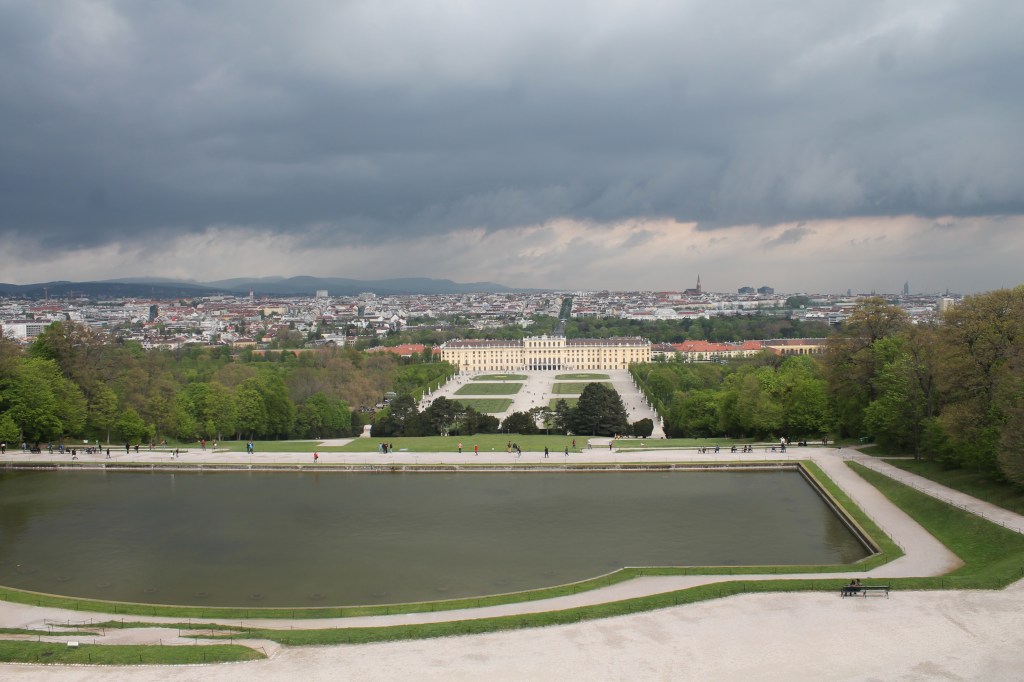
Ah, well. Day two. Now, we’re talking. We went to Schönbrunn Palace. The interior is not half as pompous as the Hofburg, I suppose, but the visit itself spoke far more to my own heart. The Palace is large and lovely, but what truly gets you is the gardens. Be prepared for a very, very long walk. A very, very, very long walk. A very, very, very… you get the idea. Be prepared to be absolutely exhausted. And I was. I saw a lot more of Elisabeth there than elsewhere in Vienna, in spite of all the merchandise, but I was also a lot more tired by the time I finally reached the Gloriette, which is a small recreational building at the top of a bloody hill that seems to never have an end. I have the habit of always climbing the highest tower upon any visit, of course, so I climbed to the top of the Gloriette. It was March, it was cloudy, it was mostly empty, too. From the top of the Gloriette, you can see the whole of Vienna. It was absolutely silent and absolutely peaceful. I’d been going through some rough times, back then – I was just finishing my MA and putting a lot of pressure on myself, and I’d just lost my faithful companion, a 12-year-old black cat, to a disease. I was in a pretty gloomy state. And then I climbed to the top of the Gloriette, and I heard the quiet, and I thought that perhaps one day, many years ago, Elisabeth may have gone up there too and heard the quiet. That even though she hated Vienna, she may have acknowledged its beauty, and found that little moment of peace there, at the top of those columns. I got that sort of positive, semi-sad melancholy you feel when something is simultaneously sad, sweet and peaceful, and I think that was the moment in Vienna when I truly found Elisabeth.
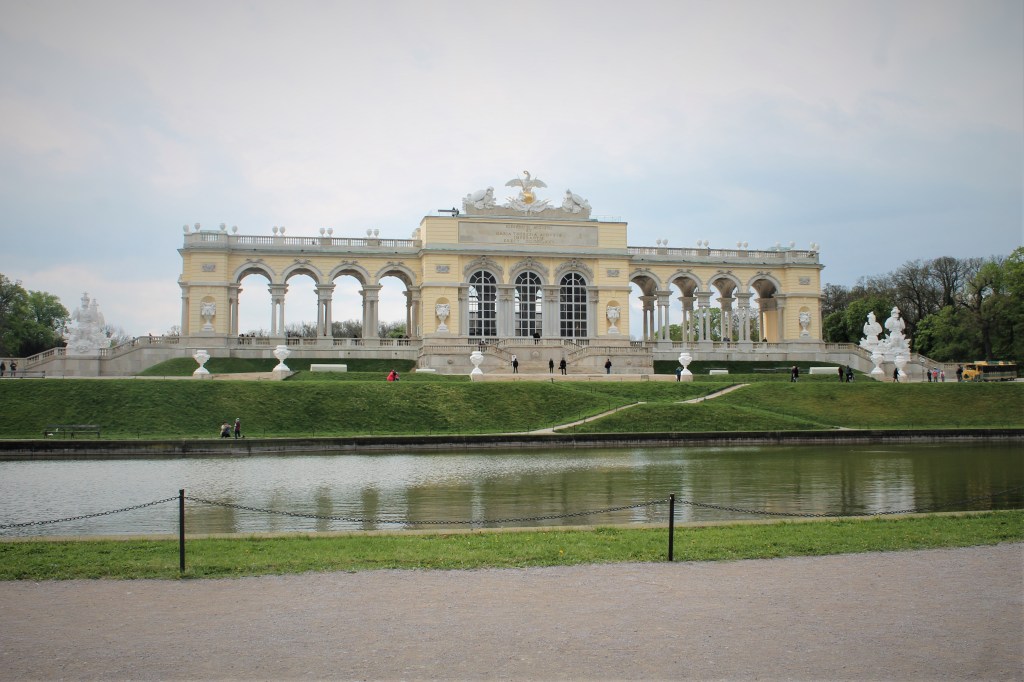
I have no idea if Elisabeth ever went there, mind me. I don’t even know if she would have liked me, nor whether I would have appreciated being her friend. She was a difficult person. But somehow, I felt, and I still do, that I kind of get her and, for that reason, even if we are one-hundred years away from each other, she may have understood me, if only a little bit. At the top of the Gloriette, I had a magnificent feeling: that the only thing separating us in that precise moment was time, a feeling I’d already had, to an extent, while I was standing next to her tomb, and when I entered the Augustinerkirche. We shared the exact same physical space – she was inside that church, maybe standing exactly where I was; her mortal remains, once inhabited by her poetic spirit, were within that tomb, and a century ago they would not have been mortal remains, but rather the flesh of a living and breathing person. Atop of the Gloriette, it was only the two of us, and if time-traveling were possible, we may as well have been together there. This all sounds rather odd, I suppose, but there is something comforting to me in it. Sometimes, we get the feeling that people a few decades, a few centuries ago, may have understood us; that someone who died many years before our own birth would have been our best friend. To be where they were is a way to feel that only time is separating us, and this feeling goes to a deeper emotional level that I cannot really explain in words. Has any of this ever happened to you?
There was another factor that contributed to finding Elisabeth in Vienna during that trip. I finished her biography. Of course, a three or four-hundred page book is hardly enough to get to know a person, but you get somewhat of an image. Glamourous, decidedly glamourous, selfish, most likely, vain out of a lack of self-esteem, extremely emotional, extremely sensitive, and with the entire potential to be extremely nurturing and loving, if someone had caught her hand and helped her, but Elisabeth could not do it alone, and could not establish her own ways in the Viennese court, and change rituals which were centuries old, on her own. We see the finished picture of her beauty, but what we don’t see is what Elisabeth could have been. She was all feeling, all individuality, not in a bad way, but in a way that was very much the spirit of Romanticism: introspection. She was a thinker, and there was nothing wrong about that. Elisabeth’s life as an Empress is a world of What Ifs. What if someone had understood her better, and helped her adapt to her new life whilst accepting her differences? We will never know, as Elisabeth never knew. Her emotional response to the difficulties that surged was to close up within herself, and that prevented the world from seeing and appreciating some of the best qualities she probably had. She did not feel she belonged in that world, and she spent all her life chasing after something that she could not quite grasp.
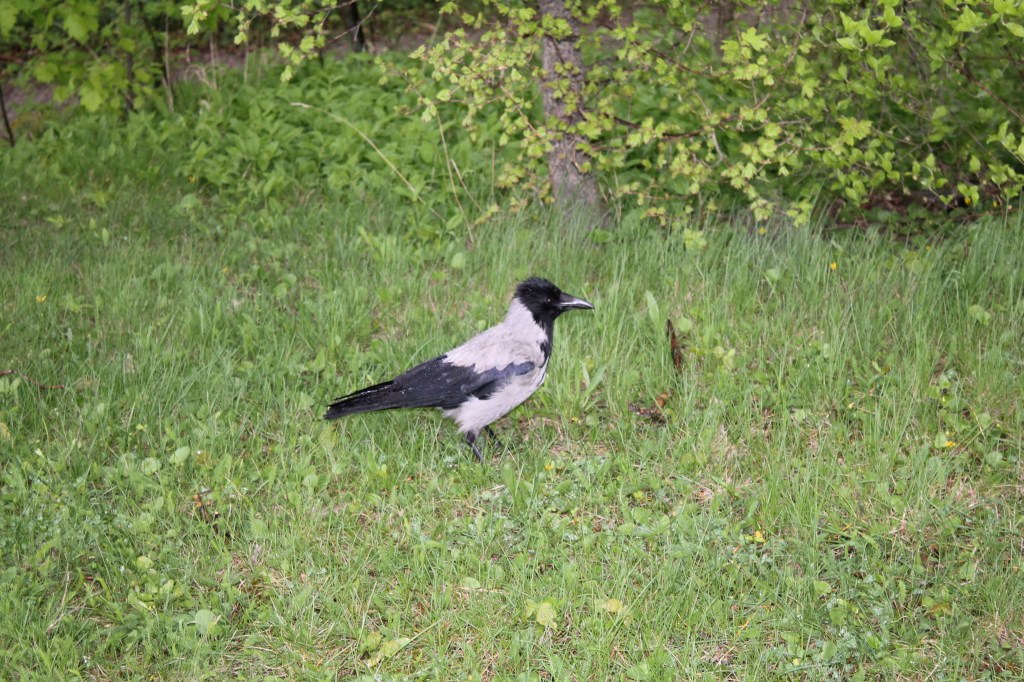
The rest of my trip to Vienna went on, very much without the Empress in the mix. I went to the Natural History museum, which was a delight, and I saw a crow stealing fries from a rubbish bin. The best bit of it, however, was having lunch in the Gloriette – the restaurant preserved its 19th century vibe, it had a very nice lasagne, and then I got to try actual Apfelstrudel, dipped into warm vanilla sauce and now I am really regretting not having taken a picture of that extraordinary piece of dessert. I could spend thousands of posts just talking about Elisabeth, analysing every small detail of her life, but this post isn’t about that. This post is about a historical figure that touched my existence in some way, a figure that appeals to me, and how I travelled to find her. I hope I have many more such experiences. And I hope you will tell me your own.
 The Historian Chronicles
Nice images. Empress Elisabeth used to hike up to the Gloriette 16 times a day, some contemporary described. The park in the 1890s was already public, so a random passerby could even meet her on the rare occasions she dwelt in Vienna! Best regards! 🙂
LikeLike
Thank you very much for commenting! That is amazing to know! Is there any source where I can read more about this? Because I would love to 😁
LikeLike