

Odin’s been promising this post for a while, and I’ve finally come around to write it. I’ve been working on the final version of my PhD thesis, and it has finally been handed over, Odin be merciful, so now I can finally obsess about all the typos it has and focus on different things. May Jules Caesar forgive this treason, but everyone who’s been following this journey of blogging probably knows that I’m a very keen Jane Austen adept, and that her books have been my constant companions since, at least, the first moment I set my hand on Pride & Prejudice, over thirteen years ago. She can often become a bit lost in the midst of all the other 19th century authors, who write heavy books with deep moral reflections, or compelling tragedies, or brick-sized novels that I love to read and carry in my heart at all times.
But that’s undervaluing all that Jane Austen really brought. I find it extraordinary that she, without using narrative devices that result on heavy writing, without engaging in the usual dense and extensive 19th century descriptive style, without even writing books longer than two or three-hundred pages, managed to tell such compelling, heartfelt stories, that are not at all devoid of meaning and still feel compelling to read, 200 years after her death. Listen, it is a lot harder for a writer to make a point come across with scarce words and little description, and to genuinely stick to the story and tell it, without any further embellishment than the plot itself; and that is what Jane beautifully does, constructing simple but realistic plots (even though no one poops and there are no poor people in her stories). She is telling the story of a specific world within the world, pass the redundancy: the world of the 19th century bourgeoisie, those who were wealthy enough to live pleasant, comfortable, even lazy lives, but who were not mingling in the restless, reckless and often far less morally balanced world of high nobility.
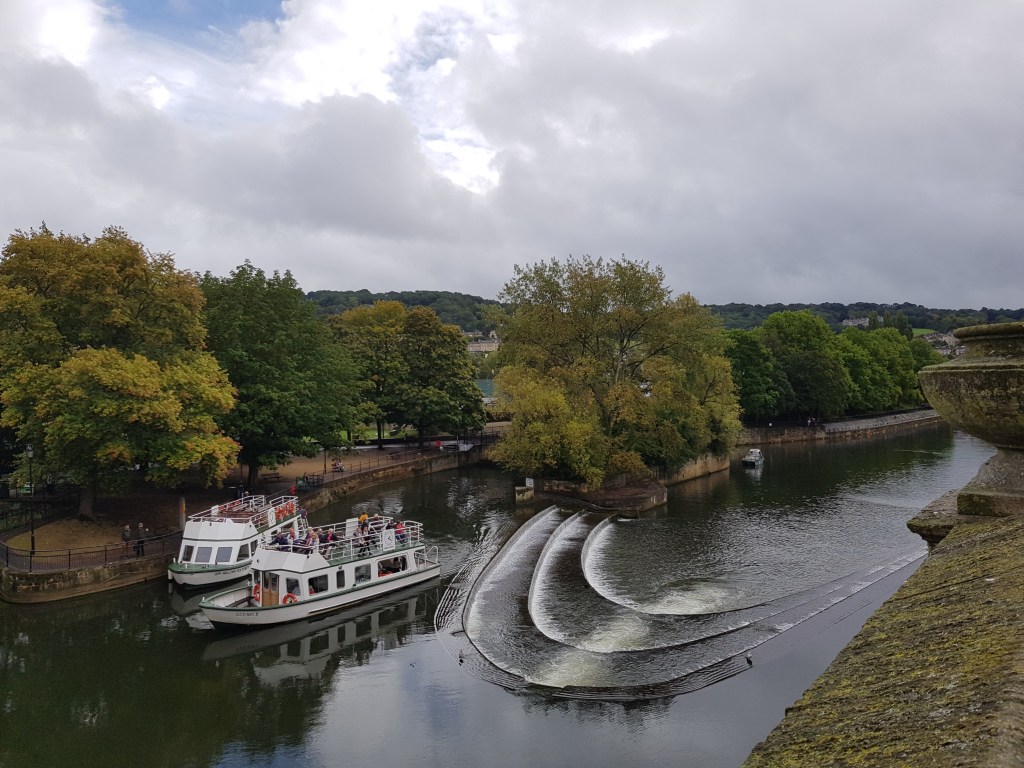
Jane Austen lived in several places throughout her unfortunately not too long life, and one of those places was Bath, United Kingdom. The name itself is very suggestive: Bath, where you can find the old Roman Baths and the former temple of Sulis Minerva, a place which became particularly fashionable for its healing properties after Her Majesty the Queen Anne went there to deal with her health problems. I visited Bath twice, and hope to visit again. It is a lovely city, very pleasant to look at, with those light yellowish tiles used in construction, surrounding by pleasant English countryside, with Roman archaeological sites and a Patisserie Valerie. To make it even better, it is really close to Stonehenge, which is always an impactful visit. Bath has all the qualities that I appreciate in a city, and I came back quite delighted, especially as I’d just gone to a Jane Austen-related event, of which Bath has plenty year-round. I even visited the Jane Austen Centre, and got some pretty cool souvenirs.
But my opinion on Bath is one, and Jane’s is another. Much has been said about her feelings regarding Bath, and they’re not often pointed as the most pleasant. She incorporated the cities into her stories, and what I bring you today is a light, short analysis of the way Bath is presented in them. Out of the main six books that reached us (not counting Lady Susan / letters / short stories), the two that speak of Bath more intensely are Persuasion (my personal favourite) and Northanger Abbey; both have storylines occurring in Bath, and the city life will have its influence upon both Anne Elliot and Catherine Morland.
I’m going to start with the latter, and leave my favourite to the end. In Northanger Abbey, bath appears for the first time related to the Allen family, a couple who become rather fond of Catherine Morland and invite her to visit with them. Mr. Allen, a landowner of «the property about Fullerton, the village in Wiltshire where the Morlands lived», unfortunately had a «gouty constitution», and therefore was packed up to Bath, to see if the waters could improve his situation. Fun story, if you go to the Roman Baths, you can actually taste the waters. Fun story, don’t. Kidding. It’s a really amusing experience, and I do it every time I visit. That doesn’t mean it’s tasty. Be warned and drink at your own peril.
So Mrs. Allen takes Catherine to Bath, because «if adventures will not befall a young lady in her own village, she must seek them abroad. Catherine is described as a young, sweet, cheerful girl, «without conceit or affectation of any kind», rather on the shy side, with a pleasant figure, pretty «when in good looks», and overall «uniformed» (auch), seventeen years old and still rather unaware of the ways of the world, as she had lived a shielded, happy existence at her parents’ home, with her many siblings. Leaving to Bath with plenty of maternal recommendation, she starts the first six weeks of youthful enjoyment in her life, it seems, and she is very pleased with the idea: «all eager delight», looking all over the city, and very excited to stay at the hotel in Pulteney Street. Jane Austen says that she is «about to be launched into all the difficulties and dangers of a six weeks’ residence in Bath». First red flag.
This Miss Morland, while off and about Bath, meets the hero, of course, Mr. Tilney, and he is the one who gives a list of the chief entertainments of the city: «the Upper Rooms, the theatre, and the concert», as well as the “Lower Rooms”. Catherine had been there a week, and had visited all three, and was pleased with all. Mr. Tilney, however much Bath entertained him, was not as excited – as an older and more travelled men, Bath probably didn’t exercise the same attraction. He underlines the particular matters of existence in Bath, the civilities, the many small details of daily life which, he playfully says, could fill up a journal: the «civilities and compliments of every day to be related as they ought to be», the «particular state of [her] complexion, and curl of your hair to be described in all their diversities». Bath seems very interesting to Tilney, so interesting that the most you can do is to tell your cousins about how fashionable you are in every given occasion.
Mrs. Allen, on the other hand, is not as displeased by the city as Tilney, and finds great entertainment in it: shopping. «There are so many good shops here. We are sadly off in the country; not that we have very good shops in Salisbury, but it is so far to go». Tilney is evidently amused by the muslin and linen conversation, and enjoys Bath so very much that he is never in the pump-room when he ought to be (namely when Catherine is there): «every creature in Bath, except himself, was to be seen in the room at different periods of the fashionable hours; crowds of people were every moment passing in and out, up on the steps and down; people whom nobody cared about, and nobody wanted to see; and only he was absent.» Mr. Tilney doesn’t seem to be the biggest fan of Bath’s social life.
Miss Thorpe, the antagonist, is more in-sync with Catherine and Mrs. Allen. She was twenty-one, as she is said to be four years older than Catherine, and therefore compared «the balls of Bath with those of Tunbridge, its fashions with the fashions of London»; Thorpe can also «rectify the opinions of her new friend in many articles of tasteful attire», discover flirtations, «point out a quiz through the thickness of a crowd». They quickly become friends, although they could not possibly be more different between themselves, and if Mrs. Allen is associated with the frivolous side (shopping), Thorpe is the gossip, and Catherine is the only one appreciating the city for its novelty and the pleasantness of meeting a new site.
Jane Austen’s snide remarks, which are always highly amusing and entertainment, start to appear in chapter 5: «for a fine Sunday in Bath empties every house of its inhabitants, and all the world appears on such an occasion to walk about and tell their acquaintance what a charming day it is». The word BATH is mentioned in this novel at least 83 times, and it is constantly in the mind of the heroine, but often in association with the famous Tilney: he was an elusive creature and difficult to find, «nowhere to be met with», neither «in morning lounges or evening assemblies; neither at the Upper nor Lower Rooms, at dressed or undressed balls», «nor among the walkers, the horsemen, or the curricle-drivers of the morning»; «his name was not in the pump-room», either. These geographic notions continue to appear later in chapter 7, far more elaborate than before: «Everybody acquainted with Bath may remember the difficulties of crossing Cheap Street at this point; it is indeed a street of so impertinent a nature, so unfortunately connected with the great London and Oxford roads, and the principal inn of the city, that a day never passes in which parties of ladies, however important their business, whether in quest of pastry, millinery, or even (as in the present case) of young men, are not detained on one side or other by carriages, horsemen, or carts.» The busy life of Bath, the movement, the city hub-hub, are something that Austen doesn’t seem to greatly appreciate, and she voices that displeasure again in the voice of Henry Tilney, who, while dancing with Catherine, asks her whether she still likes Bath as much as she had when she arrived (Bath. Bath. Bath, Bath, Bath, Bath).
«Bath, compared with London, has little variety, and so everybody finds out every year. For six weeks, I allow Bath is pleasant enough; but beyond that, it is the most tiresome place in the world. You would be told so by people of all descriptions, who come regularly every winter, lengthen their six weeks into ten or twelve, and go away at last because they can afford to stay no longer.»
Half of Catherine and Henry’s early romance is basically them having friendly, amusing conversations about whether Bath is pleasant or not! Notice the genius of Austen: she creates one motive, one which we keep forgetting, because so many events pass in between; but when we look at the book as a whole, it keeps reappearing right in front of us, the book-long jest about whether Bath is pleasant or not. I shall cut this here and call this part one, as this is growing long. I will finish with a phrase of Henry Tilney, which I believe draws close to Austen’s heart and probably explains a great deal of why she disliked it: when Catherine states that Bath life and country life are rather similar, he says:
«But then you spend your time so much more rationally in the country.»
 The Historian Chronicles