
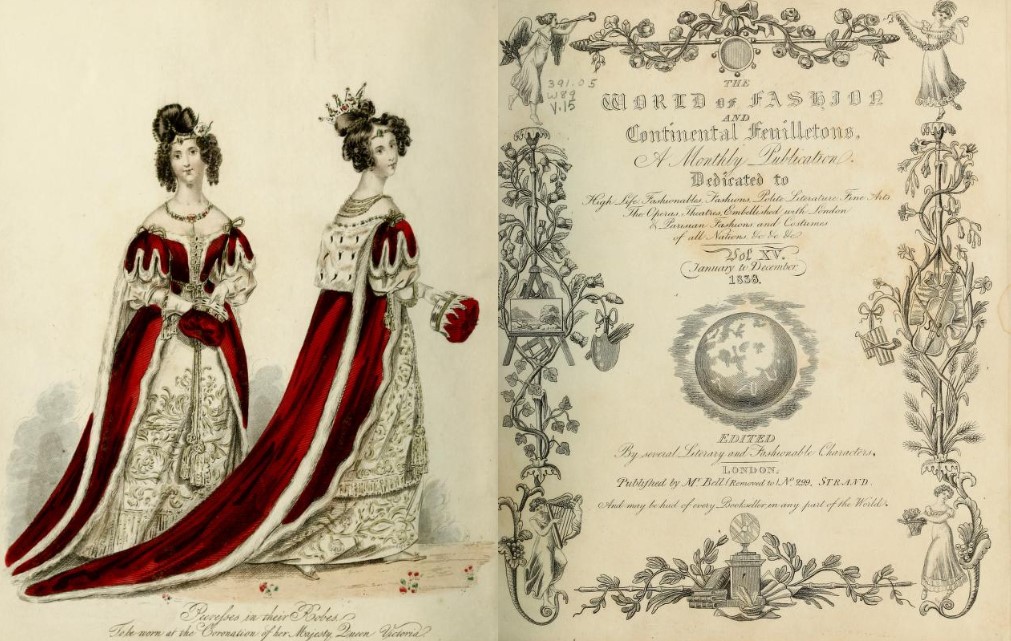
During my History roamings, I usually go and dig into period sources, which are the best method to actually get first-hand insight about historical periods. Biased they may often be, but they are one of the main objects of study, and often times it happens that I stumble upon very amusing excerpts. One of the most profitable places to find them is newspapers. Gossip tabloids aren’t exactly a new thing – people in the past also wanted to know what “celebrities” were up to. In the 19th century, these pieces of gossip can actually get a bit snarky. A few days ago, I stumbled upon several editions of the World of Fashion and Continental Feuilletons, and I’m bringing you today some of the funniest bits.
Page 3: (Italics as in the original text)
LOVE AND MUSIC. – A most amusing occurrence in high life is just now the subject of much pleasant conversation. An adventurer, possessing a favourable exterior and “polished manners” (these adventures are always handsome and polished) and who represented himself to be a Polish emigrant, recently obtained an engagement, to teach music in a family not a hundred miles from B—– square. Monsieur was a most persevering master of his art; his attentions to his pupil (a graceful girl of nineteen) were most devoted, indeed, it was thought that his visits were more frequent than it was necessary that they should be for the instruction of the young lady. At length, this modest professor of the guitar, declared his passion for his charming pupil in a letter, which the young lady with that good sense which does not always prevail in similar situations, placed before her family, and of course, Monsieur received an immediate dismissal. On the following day, however, while the ladies were out in their carriage, the guitarist called at the house and requested permission to fetch from the drawing-room, some music books which he had left there. This was granted, and when the family returned the found the following sentence written on a piece of paper, in pencil, “C’est ainsi qu’en partant je vous fais mes adieux.”. A valuable gold watch is missing!
(French text: This is how, upon leaving, I bid you my farewell)
Page 4:
A RETURN. – Young Lord —-, whose puppyism is remarkable, recently made a declaration to one of the prettiest stars of fashion, Miss A— R—. We do not undertake to say what the terms of the letter were which young scapegrace sent to the lady, but judging from his characteristic arrogance and vanity, we imagine it was a bold one. However, the offer was rejected, and a day or two afterwards, some waggish friend sent to the poor young Lord, in the lady’s name, a very handsome foolscap and bells, which we hope his Lordship may long enjoy!
Page 4:
A CURIOUS FACT. – Lady E —-, who is never so well as when she is ill (a paradox which her physician could explain in a moment) is always free from complaint at Christmas! During the holidays she can exist without a prescription! This is a curious fact. A re there not many like poor Lady E—-, who make maladies for themselves, and to whom the idea of pleasure is of more efficacy than all the physic in the apothecary’s shop? Now, here is Lady E—-, who is continually pouring down her throat unpleasant draughts, and who gulps down more bolusses in one year than Lord E—- uses shot, is always welcome at Christmas, because she likes merry-making, and she knows that Lord E—- is such an affectionate hubby, that he would not have the voice of mirth heard in his establishment, if he thought her ladyship in ill health.
Page 4
D’O —- Y’S BEAVER. – We understood that D’O—-Y’s hat is the subject of much grave disputation in the boudoir of Lady B—–N. Her Ladyship, with her characteristic good taste, objects to her friend and relation wearing anything so ugly. D’O—-Y, on the other hand, contends that his beaver is a beauty, and manfully declares that he would rather part with his whiskers than part with his peculiar hat! D’—-Y is, however, in the wrong; and as he is noted for being a gallant man, we submit to him the propriety of acquiescing in the views of Lady B—-N. He should allow her Ladyship to give his hatter an order for him.
Page 51 (I particularly like this one, it is very unusual and sounds like a proper love story x’D)
4. – THE PATRICIAN AND THE PLEBEIAN
Another “distressing case!” Hearts will be hearts! And Love often links strange ones together. The nephew of a Marquis, and a menial! What a disparity! The young gentleman who has thought proper to commit this freak, is the eldest son of Admiral the Hon. Sir —-! He has actually married one of his father’s servants! The young gentleman is an admirer of levelling opinions, no doubt. The painful effects of this thoughtless act, are increased by the bridegroom having several unmarried sisters, moving in a distinguished circle, to whom this connection, besides being repugnant, may possibly be disadvantageous also! How shocking it would be if the young ladies were to imitate the example of their brother, and take a journey to Gretna, with butler, footman and groom!
Comment: A clear example of class division in the 19th century, and how hard it was to move between them. Not only does the newspaper criticise it heavily, but it also acknowledges that this young man’s choice would have been detrimental to his sisters’ position in society, and their likelihood of marrying well. Whether it caused a family dissent, they do not tell us. The newspaper talks of Gretna: Gretna Green was a place in Scotland where runaway couples usually went to get married, as marriage laws were different and more permissive. You can see this in Pride & Prejudice: although it did not come to pass, the characters believe that Lydia Bennet may have run away to Gretna Green, so she could marry Mr. Wickham.
Page 52 (a very British humour)
A HUME-OROUS PUN. – A member of one of the Clubs has expressed his regret that Sir JOHN GIBBONS had resorted to legal measures against MR. HUME, instead of posting him, in the usual gentlemanly fashion. “For if he had done that,” said the Club wit, “he would have enjoyed what no living man can be said to have enjoyed, a Post-hume-ous reputation (posthumous).
Pages 52-53
REMARKS AT COURT. – It was remarked at the Drawing Room, that a certain fair Countess, who has turned away heads in her time by her loveliness, and whose attachment to the gaming-table has for some time been a subject of general regret, appeared in a dress that had been sported at Court twice before, at least. The ingenious arrangement of ornaments and trimming, did not prevent the old dress from being recognised; and her ladyship, though she may have fancied that she came off with flying colours, was certainly detected, and we have reason to believe that her ladyship will be made aware of the notice that was taken of her error.
Comment: This type of snide remarks makes one understand the pressure that Royal women and other members of nobility faced when presenting themselves in society. This woman is criticised for appearing in Court three times with the same dress – as if two was not bad enough. In the 19th century (much as today), people often tried to reuse their old clothes and give them a new life, and this lady seems to have attempted to make it pass for new through new decoration. However, the sharp eyes of others seem to have noticed it, and she was thus publicly embarrassed in the local paper.
Page 72
AN OBSTINATE YOUNG LADY. – A very amusing circumstance as lately occurred at Marseilles. A young lady brought an action against the Sieur L— for unhandsome behaviour on his part. The day of judgement approached, the Court was crowded – and a very fair proportion consisted of that sex justly immortalised by Milton as “Heaven’s last best work.” The usual questions were proposed to the pretty plaintiff by the President. “Quel âge avez vous?” “Dix neuf ans, Monsieur.” “You mistake, Mademoiselle,” interrupted her counsellor, “you are of age.” The lady, however, persisted that she was a minor, and in spite of the earnest appeals of her avocat, still adhered “dix-neuf ans.” Nothing could induce the fascinating descendant of Eve to pass the rubicon of nineteen years; and there being no proof before the Court to the contrary, the complaint against the Sieur L—- was dismissed, and the “young lady” in her teens condemned to pay the costs. Registerial report has since then proven that the beautiful maid had attained the discreet age of 25.
Page 72
AN UNGALLANT COURTIER. – Lord D—-, who prides himself upon what he terms his habit of plain speaking, which, by the way, often becomes sheer impertinence, one day addressing the amiable and accomplished Miss —-, exclaimed, “My dear girl, how very red your hair is!” “Possibly, my lord,” was the lady’s quick reply; “but your lordship is the first man who ever thought of telling me so!”
Page 77
A CURIOUS QUERY. – What does Colonel H—– do every morning, at eight precisely, in the neighbourhood of —- Square, and alone? Does the gallant officer think an early ramble good for his health. Is the atmosphere lighter – the air purer in the comparatively confined neighbourhood of —– Square to what it is in his own open neighbourhood? Or can it be that he is studying the pleasing art of telegraphing with his fingers, and taking lessons occasionally from a two pair of stairs window, where the pretty —–. But we will not injure the gallant Colonel’s prospect. We know him for an honourable man, and we wish him success in all his undertakings, Vive l’amour, viva la guerre.
Comment: The ever-vigilant 19th century society. A young man going to a square every window to have a moment of communicating alone with a woman he was courting, as he probably wasn’t allowed to have much privacy with her during social situations. The newspaper, however, isn’t really helping is case, is it? This is a time of blurry morals, in which the theory demands for what we common see as Victorian morality, but the practice shows something very different, namely that these people were humans, just like us.
Link to one of the editions:
https://archive.org/details/worldoffashionco15lond/page/n9/mode/2up
 The Historian Chronicles