
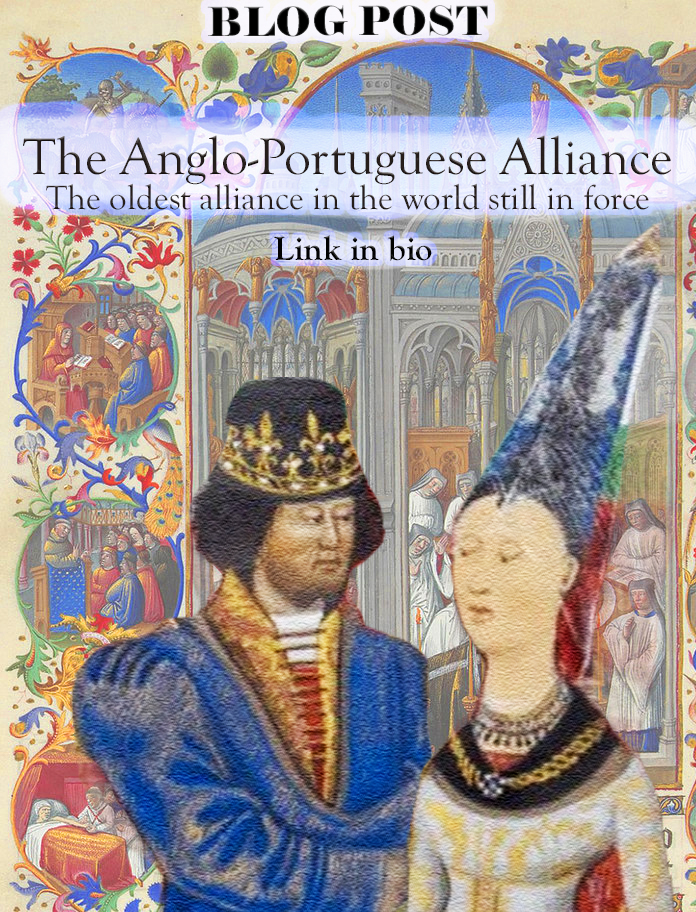
The Anglo-Portuguese Alliance is oldest alliance in the world still in force.
I usually don’t write about the Middle Ages. I’m not particularly great with Palaeography (the beautiful art that talented people use to read Medieval texts), and as you all know, I prefer to work directly from the source. However, there are subjects that I’m so passionate about, I end up writing a word or two about them; therefore, this is the first of (hopefully) many posts that drift a little from my usual realms of Ancient History and the 19th century.
The Alliance between England and Portugal is the oldest alliance in the world which is still in force. This is not at all related to the fact that England is very fond of Portuguese Port wine, in spite of the significant investment in vineyards by English immigrants during the 19th century in the district of O’Porto. To understand this alliance, we must go further back, all the way into the 14th century, and look into Portuguese, English and Castilian politics.
Let’s start through the background of each of them:
Kingdom of Portugal
Between 1325 and 1357, Afonso IV the Brave reigned in Portugal. This King had only one rightful male heir, Pedro, who was married to a Castilian noblewoman, Constanza Manuel. However, Pedro developed a liaison with one of her ladies-in-waiting, Inês de Castro, and they had several children together.
When Constanza died in 1345, Afonso VI thought it would be convenient for his son to marry a foreign princess, or someone who could benefit the Royal house; Inês, albeit being a noble, was not a beneficial match for Pedro. However, Pedro allegedly married Inês (whether he truly did it or not, we do not know, but he claims to have done so) in 1354. Afonso VI was severely displeased, and after a while, under the influence of other nobles, he gave the order for the execution.
Inês being executed, Pedro, who came to be known as the Just, or the Cruel, turned against his father and Civil War ensued. It ended in reconciliation, and Pedro succeeded as Pedro I, with little issue, in 1357. He never remarried, although he had other liaisons and more children; his successor was his only son with Constanza, Fernando I, known as the Handsome.
Fernando also had a fairly unpopular marriage. He was connected to Leonor Teles, a noblewoman from the North of the Peninsula (whether from Portugal or Gallicia or Castille, it is not quite certain). They had at least three children, but only one child, a girl, survived into adulthood, namely Infanta (the same as Princess, explained in another post) Beatriz.
Infanta Beatriz was married to Juan I of Castille, and the project was to unite the Portuguese and Castillian crown. However, when Ferdinand prematurely dies, at the age of 37 (year of 1383), there are several factions who do not have any interest in a political union of the two kingdoms, some for patriotic reasons, others not quite so, as is usual in such affairs. Therefore, pretenders start to appear.
As is natural, Inês’ surviving sons are amidst the pretenders; João and Dinis were their names. Another pretender is yet another João, who was a son of Pedro I of Portugal by another lady (Teresa Lourenço), born after the death of Inês. Courtly intrigue and perhaps a bit of mismanagement on the side of Inês’ sons lead to them being removed as pretenders and to flee into foreign courts, and this other João becomes the one pretender and is acknowledged as such by the Courts.
Thus begin two years of Civil Wars. João’s life may have been pretty uneventful otherwise, in a Middle Ages way: he was born on the 11th April 1357, and only came to prominence at the age of 28, in 1385, when he became King of Portugal. Wars between Portugal and Castille were a constant all throughout the Middle Ages, but they used to happen for the sake of border territories; now, João would have to fight a war for succession, to keep an entire country independent.
There were two priorities in João’s life, as of now: heirs and alliances. An alliance can also bring heirs, of course, as it is often concluded through marriage, so courtly politics immediately are set in action, and his supporters start trying to find him a wife.
Meanwhile, in the Kingdom of Castille…
Pedro I of Castille, called The Cruel or the Just, was born on the 30th August 1334, and he reigned until his death, on the 23rd March 1369. He was married quite a lot of times, and caused quite a lot of trouble. During his marriage to Blanca de Borbón, he claimed to have also married María de Padilla, who later gave birth to Constanza. Through political intervention, he manages to have Constanza and her siblings legitimised in the Courts.
In the year of 1366, Enrique II of Trastámara takes the Castilian throne. He was the illegitimate half-brother of Pedro I of Castille. As Pedro had legitimised his children by Maria de Padilla, and as Constanza was the oldest surviving child, she claimed the Castilian crown for herself.
And in merry old England?
In that sequence, Constanza marries John of Gaunt, whereas her sister, Isabella, marries Edmund, the 1st Duke of York. John of Gaunt takes it up to attack Castille and claim his new wife’s title, in her name and that of their only daughter, Catherine of Lancaster.
It just so happens that John of Gaunt had other children by his previous wife, and his eldest child was, in fact, a girl, better yet, a woman, who just so happened to be single.
Philippa of Lancaster was the child of John of Gaunt and Blanche of Lancaster. Her mother was one of the wealthiest women in England, and Philippa was the grandchild of Edward III of England and the niece of Edward, the Black Prince. After her mother died, most likely due to the Bubonic Plague, she was raised by her governess (and her father’s mistress), Katheryn Swynford; of course, scandal ensued, but Katherine and Philippa seem to have been in friendly terms, and her father ended up marrying Katheryn later in life, after Constanza died.
Philippa was three years younger than João I of Portugal. In a time when young princesses were married off rather early, she was past the usual marriageable age; however, the Portuguese didn’t see it as an impediment at all, and if João sorely needed an heir (under risk of another succession crisis if he died without one), he trusted that his marriage to Philippa would result in a child.
This alliance seems pretty much meant to be. Two people with a common enemy, who are fighting the same land; a King who needs to marry, and has lost the usual provenience of Portuguese Queens (as Portuguese Kings usually married Castilian or Aragonese ladies.
The Anglo-Portuguese alliance has roots even before all that. On the 16th June 1373, Edward III of England (Philippa’s grandfather) and Ferdinand of Portugal signed a treaty of «perpetual friendship, unions and alliances», with the expressions “Amicitae” (Friendship), “Alligantiae” (Alliances) and “purae Dilectonis foedera” (leagues of sincere affection” being used; assistance is promised by land and sea, against any enemy (yes, I did use the Wikipedia translation).
However, the probably better known moment of ratification of this alliance is the 9th of May 1386, when the Treaty of Windsor is signed, and the marriage of João I and Philippa of Lancaster is finally and definitely agreed. The pact is then fully established and enforced, and the English and Portuguese will be connected throughout History.
Centuries later, when Napoleon Bonaparte declares the Continental Blockade, the Portuguese refuse it on account of this alliance, which leads to the Portuguese Royal Family having to flee to Brazil, and to the Peninsular Wars between the French army and the Anglo-Portuguese forces.
Later, and since today (24th May) is the birthday of Queen Victoria, one can observe the deep personal and political alliances between the United Kingdom and Portugal, in the person of HM Queen Victoria and HM Queen Dona Maria II of Portugal.
João and Philippa had a very successful marriage. They had eight children together, of which mostly male heirs, which were important to secure succession. All these children were well-educated and well-learned, to such an extant that, even to this day, they’re known as the Illustrious Generation. Unfortunately, Philippa suffered the same fate of her mother, dying at the relatively young age of 55 from the Black Plague. Their children, however, had a fundamental role in the Portuguese ultramarine expansion, with all the positive and negative sides it will bring to World History.
And the alliance? Well, it’s still on, and I want to believe that the English and the Portuguese still get along pretty well!
 The Historian Chronicles