
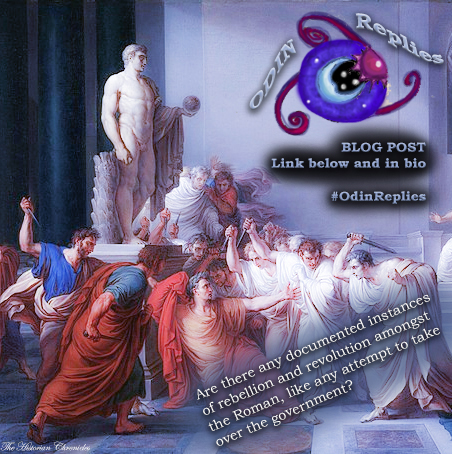
Are there any documented instances of rebellion and revolution amongst the Roman, like any attempt to take over the government?
Odin’s reply:
L-o-a-d-s.
The daily life of the Roman Republic, especially during the late years and the transition into the Imperial period, was made of revolts. If you weren’t having a revolt, you weren’t living a regular day. You had revolts by the Roman Prouincias, you had revolts by the slaves, you had Civil Wars, literally everything and anything you can imagine.
Some short examples:
- 121 BCE – The Gracchi brothers (by names of Tiberius and Gaius) were two well-known tribunes of the Plebs who tried to introduce novelties in the agrarian laws. Several of Tiberius’ supporters were killed. Years later, his brother was going to be attacked by a mod and, allegedly, suicided on the Aventine hill. His supporters were also executed, those that were caught.
- 91 – 88 BCE – The Social Wars. The Roman socii, which were allied city-states, rebelled against Roman policies. Rome technically won, but the Socii eventually all got Roman citizenship just the same, and were integrated in the Roman Republic as citizens of right.
- 88-87 BCE and 82-81 BCE – Civil Wars between Gaius Marius and Lucius Cornelius Sulla. Marius was the great saviour of Rome during the invasions of the Cimbrii (a Germanic tribe), and was elected consul seven times (which is quite unusual and extraordinary for that day and age). Sulla actually started his career alongside Marius. He attained the control for the Mithridatic Wars, and Marius was not particularly happy about it. Amidst that and attempts to gain political control, Sulla and Marius ended up on opposing ends, and the wars may have gone on if Marius hadn’t died in the year of 86 BCE, of natural causes.
- 73 BCE – Third Servile War, better known as the war of Spartacus, in which Spartacus, Crixus, Gannicus, Oenomaus and Castus attempt to secede from the Roman world. It took two years to put an end to this rebellion, and it cost many thousands of lives on both sides; ultimately, the former gladiators were defeated.
- 80 – 71 BCE – Sertorian War. Another rebellion with a view to secede, fought between two different Roman factions; the rebelling side was commanded by Quintus Sertorius. This was set in the Iberian Peninsula, and Rome was victorious yet again.
- 49 – 45 BCE – Julius Caesar and Pompey’s Civil Wars. This was another long conflict between two Roman factions, and as you can see, having lasted four years, there was relative balance for a while. Julius Caesar was ultimately victorious: after having lost a battle, Pompey takes refuge in Egypt, where he is betrayed and murdered on the orders of the pharaoh. In the following years, you have quite a few revolts by local populations in Gallia, too.
- From then until the end of the century, the revolts and civil wars will intensify. Pompey’s eldest son, Sextus, took a hold of the island of Sicily, became essentially a pirate, and was a nightmare for supplies traveling the Mediterranean to the Italian coastlines. Marcus Antonius and Cleopatra end up engaging in war against Octauianus. Several tribes revolt.
- In 30 BCE, Octauianus wins the battle of Actium (well, Agrippa does it for him). You’d think it was all good now, but it certainly wasn’t. Gallia, Egypt, Judaea, Thrace, Mauretania, Gallillee, Illyria, Germania, Cappadocia, Alexandria, Britannia, Civil wars, Civil wars, civil wars, Civil wars… you name it. It just won’t stop.
- The Pax Romana is all nice in theory, but keeping the cohesion of such a vast empire wasn’t exactly easy, and it was a process in which the border was constantly altered. Furthermore, after the collapse of the Republican system, you see the Pretorian guard becoming the first strength of the Emperor and not of the City; you see the legions connected to men and not to the state. Politics change and there are more and more manoeuvres. Quite honestly, when you reach the fifth century and the foreign peoples invade Rome, it is more of a relief to break with the previous system than anything else, although, of course, the emperors might quite disagree!
 The Historian Chronicles