Odin replies: History of Fashion

Odin:So I noticed there were quite a few questions about fabric. What do you have to say about that?

Me: – Well, sir, as Professor Lupin told Harry in Harry Potter and the Prisoner of Azkaban, I will not pretend to be an expert fighting Dementors, but I’ll try to help.

I love History of Fashion. I love looking at all those beautiful clothes that very talented seamstresses are producing and posting on Instagram. I love historical reenactment (participated in a few events meself, if I might add), and there is nothing quite like wearing period costumes to make you get the feeling of a certain period.

In what comes to the Ancient times, unfortunately, we do not have any surviving specimen. The materials used deteriorated far too easily for them to be preserved. Does that mean we don’t know the first thing about ancient clothing? No! Fortunately for us, we have plenty of mosaics, sculptures, frescoes and mentions in ancient written sources that introduce us to this world of dressing up 3000 years ago. So let’s dig into that and see what we can say about today’s questions. Considering they were all surrounding the same subject, there are three being discussed here today:

What empires had what resources to create fabrics?

This is an interesting question. In theory, most empires within the same continent have the same basic resources to create fabrics, back in the ancient times and without fast means of transport. Europe and Northern Africa have to rely on their resources, then Asia, Oceania, America and Africa will have their own. That does not mean there was not trade between some of these continents, namely between the Mediterranean world, the Middle East and Eastern Asia, as you’ll see below; but raw material availability will definitely influence the fabrics most in use, especially in the lower strata of the population.

First things first.

There are two main sources of fabric materials for these ancient civilisations, namely animal and vegetable sources.

In what comes to the main animal sources, there were three main products that could be transformed into wearable fashion: wool, fur and hides.

In terms of the most widely used vegetable source for ancient clothing, it would be flax, which is used to make linen; they could also use jute, although it was not as common amidst Greek and Roman people during the Classical era. Aside from these resources, there is also the case of silk, made by silkworms.

How the use of these materials translates into actual fabric making greatly depends on two factors: raw source availability and the climate. Therefore:

  • Silk: silk has been produced in China since the 4th millennium before our era, according to Wikipedia data (lol!), with the Silk Road starting about the 1st millennium BCE. Whereas China would have been producing silk since early on, this production did not reach other regions until much later, firstly through Japan, then the Byzantine empire in the 6th century CE, then the North of Africa, South of modern-day Spain and Sicily during later periods in the Middle Ages. There’s an interesting book about the Roman Empire and Silk Routes by Raoul McLaughin (check the Bibliography below!): if you check Chapter Two, it will give you a detailed account of how silk would have been used by the Romans:
  • Romans, Greeks and other civilisations of the Mediterranean basin did not produce silk. They had it imported and used to make very colourful garments and other useful pieces of fabric to use in public events. Another interesting point made by McLaughin is that statue of the gods would sometimes be dressed in silk for religious acts and processions. So silk, to these people, is mostly something for the very wealthy and for the Gods. This silk could be woven into delicate patterns, made into damask, or even embroidered with gold.

So, if silk was for the wealthy, what did everyone else wear?

  • Mainly, wool and linen. In Ancient Egypt, for instance, probably due to climate, they mostly wore linen, made of flax fiber; in Ancient Greece, where animal breeding was one of the main sources of living and where the climate was slightly different in certain regions, wool was very popular. The same went for Ancient Rome.
  • Felt could also be used for certain clothing articles, such as the pileus, a cap that became popular in certain areas of the Western Mediterranean and, later, in Rome.
  • Cotton – not as common as the rest, it was also imported from Asia (India), and was not half as popular nor half as widespread as linen and wool.
  • There were several different combinations of these different fabrics, to create specific clothes that would have been more adaptable or more fashionable, considering the context.
  • Although most people did not wear shoes, especially in warm climates, these could be made out of leather or vegetable fiber.

And if you go north?

  • Aside from leather and wool, which would also have been used, population living in colder areas would have also invested in animal fur.

Long story short: the main materials in use in the Mediterranean world were wool and linen; silk was imported and reserved to the upper classes; there were some other fabrics, both of vegetable and animal origin, but they weren’t as widely used.

How did this contribute to the function and the style of clothes?

The resources you have and the climate you live in, as I said above, will of course influence style and function. This is a period before zippers, and even before buttons, which only appeared in a functional form for use in clothing in the Middle Ages. So all clothes stayed in place through the use of pins, brooches, ties… you name it. The ways one can pin fabric over fabric, or fold fabric over fabric, are endless, and regional variance appears throughout the whole Mediterranean. Fashion-wise, it is hard to say why a certain civilisation develops a certain style; I suppose the environment and their particular culture may have influenced them, but I can explain it no more than I can explain the appearance of crinolines and tight-lacing in the mid-19th century. Of course, we can say that women were trying to attain a certain feminine ideal of fertility, narrow waist, larger hips, etc. etc. Perhaps similar phenomena happened with the ancient peoples. There were, however, two main differences:

  • Short-haired people and long-haired people. Whereas the Greek and the Romans were huge fans of beardless, short-haired men (with shaving and plucking body hair in the mix), some regions in the Middle East, especially during the Pre-Classical period, were all for the beards and long hair, as were other peoples in Northern Europe. For instance, the Romans had the expression “Gallia Comata”, which literally means Gaul of the Long Haired.
  •  Trousers vs tunic. The Greeks and the Romans thought that trousers were a sign of barbarians, during the Classical Period. Once again, the Middle Eastern and the Northern European peoples were the pioneers of trousers, and this is very likely connected either to climate or to lifestyle. In people whose livelihood involved travelling many miles on horseback each day, for instance, trousers would have been a lot more practical. Of course, as Rome expanded, they realised that modern-day England and Scotland aren’t quite as warm, so they had to adapt and improvise, and did start wearing some types of trousers.

Some terminology just for the fun of it:

  • Ancient Greek clothes, once again from Wikipedia: chiton, peplos, himation and chlamys. The peplos is a lady thing.
  • Ancient Roman clothes: tunics. The popular toga for men, and then the palla and stola for women.

When did people weaving their fabric become obsolete in the West?

So, as we’ve seen, these materials are mostly turned into fabric through weaving. Human beans have started weaving fabric a long time ago, probably during the Paleolithic, and have gone through developing several techniques that involved the use of manual looms. During the Industrial Revolution, we start getting mechanical looms: in 1842, Kenworthy and Bulloughs allow for the semi-automatic loom, and weaving quickly turns into an industrialised activity. Of course, some people have still preserved the ancient art of manual looms, and you can purchase their fabrics by insanely expensive (but definitely deserved) prices, but from the late 18th century and especially throughout the 19th century, most weaved fabric has been transformed through mechanical processes and inside factories. This continued until our days.

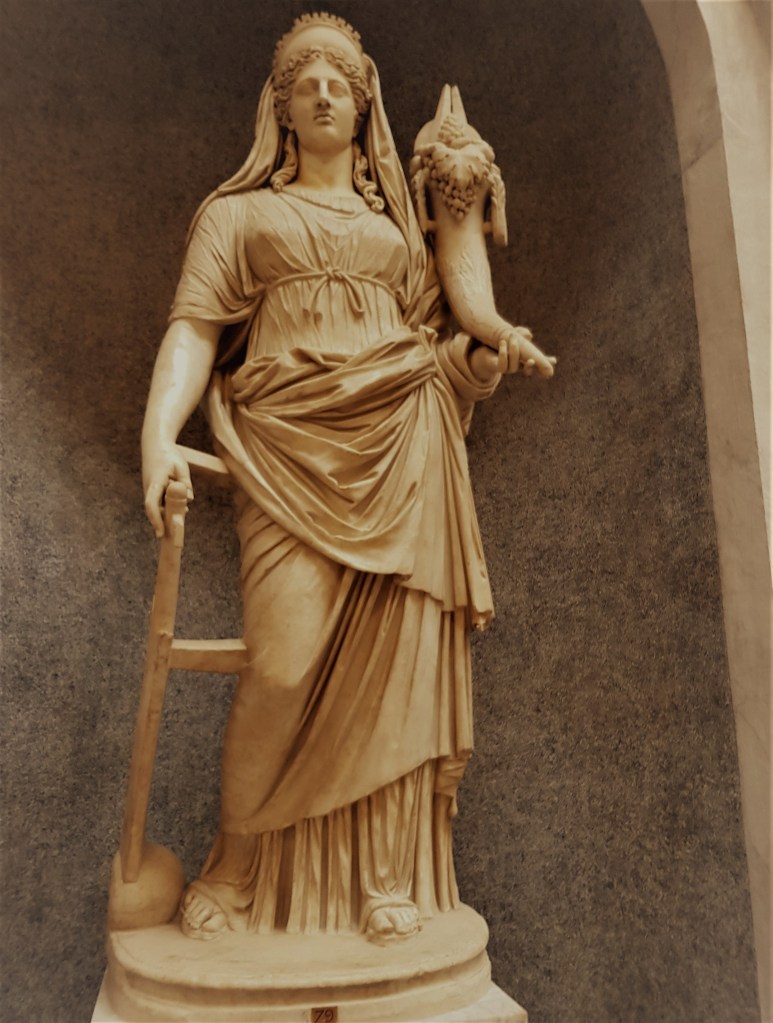
Some examples of Roman fashion below:

Statue of Fortuna, Vatican Museum. My photo.
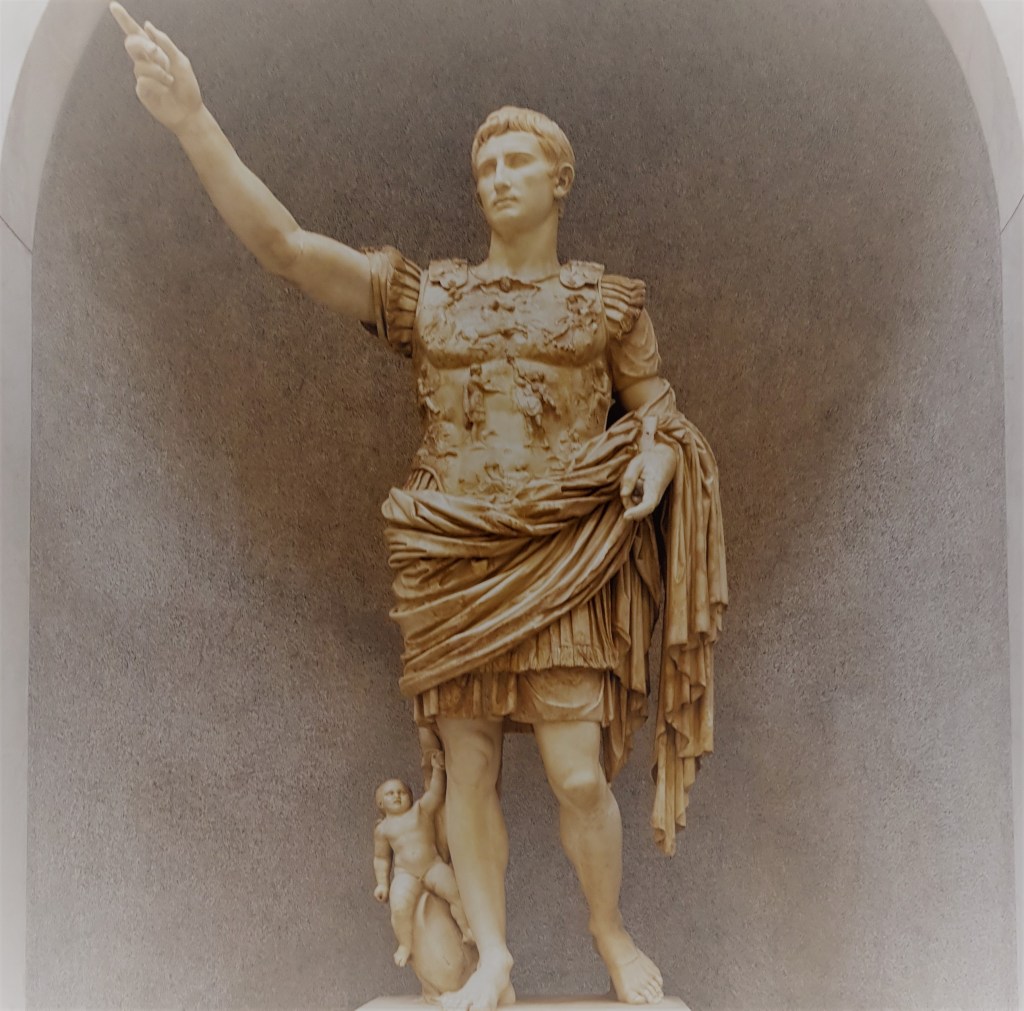
Statue of Augustus, Vatican Museum. Also my photo.

Sources:

https://en.wikipedia.org/wiki/Weaving

https://en.wikipedia.org/wiki/Clothing_in_ancient_Rome#Other_plant_fibres

https://en.wikipedia.org/wiki/Clothing_in_ancient_Greece

https://en.wikipedia.org/wiki/Roman_Gaul

https://en.wikipedia.org/wiki/Trousers

https://en.wikipedia.org/wiki/Button#Button_sizes

https://en.wikipedia.org/wiki/Gaul

https://www.britannica.com/topic/dress-clothing/Ancient-Rome

https://en.wikipedia.org/wiki/Clothing_in_ancient_Rome

https://en.wikipedia.org/wiki/Pileus_(hat)

https://www.ducksters.com/history/ancient_egypt/clothing_of_ancient_egypt.php

http://www.historyofclothing.com/clothing-history/ancient-greek-clothing/

https://en.wikipedia.org/wiki/Cotton

https://en.wikipedia.org/wiki/History_of_silk

https://en.wikipedia.org/wiki/Sino-Roman_relations

https://www.unrv.com/economy/silk.php

http://www.tribunesandtriumphs.org/roman-clothing/roman-clothing-materials.htm

https://study.com/academy/lesson/ancient-roman-textiles.html

Raoul McLaughlin, The Roman Empire and the Silk Routes: The Ancient World Economy & the Empires of Parthia, Central Asia & Han China. 2016. Pen&Sword.

Thorley. “The Silk Trade between China and the Roman Empire at its Height, ‘circa’ a. d. 90-130”. Greece & Rome

Odin replies: Do you believe in the possibility of an ancient underwater building or city since the Romans had developed concrete that wouldn’t deteriorate in water?

Sometimes, all the stars seem to align, and you find yourself saying Thank you, oh Mighty Odin. When I launched this challenge – to myself – I had no idea how many questions I’d get, nor whether I’d be knowledgeable enough to reply to them, nor whether I’d be remotely successful in bringing useful and verified information to those who asked them. I was, therefore, very pleasantly surprised, when I found that not only there were several questions, but also that I had the capacity to reply to them. To this question, in particular, I have an extra boon, because I’ve actually been working some of these subjects during my PhD (do feel free to imagine me doing a #success Meme face).

I will be replying to this question more than Odin will, because it is directly asked to me and is questioning my beliefs as a Historian. Without further ado, let’s sink into the issue.

Do you believe in the possibility of an ancient underwater building or city since the Romans had developed concrete that wouldn’t deteriorate in water?

Yes. Because we have ancient underwater cities.

For matters of practicality, I’m going to divide this reply into three parts. Firstly, I’m going to explain what this concrete actually was, how it was made, and how and where it might have been originally used in underwater contexts.

1- Hydraulic Concrete

Romans did, in fact, develop concrete that did not easily deteriorate in water. In Latin, this was called opus caementicium, and it was made in a very specific way: it combined the use of a volcanic ash, called pozzolana, with diverse types of aggregate (thus, sands or stone). This pozzolana, when mixed with aggregate, was applied to construction and left to settle, thus creating an extremely hard and very functional concrete which, the Romans soon found, could easily be used in salt water without presenting significant degrees of deterioration.

This type of concrete, however, was a relatively late discovery in the Roman world. Without entering discussions about the effective levels of settlement in the area throughout Prehistoric times, the legendary birth of Rome is set to the 8th century BCE (to be exact, 753 BCE); this type of hydraulic concrete did not appear until much later, about the 2nd century BCE, thus, at least, 600 years afterwards. It also follows that its main period of implementation as a construction material was not until the 1st century BCE.

To give you some degree of comparison, Petra (in modern-day Jordan) was made around 1200 BCE, the Parthenon in Athens about 440 BCE (give or take a few years), and the Colosseum in Rome between the years of 70 and 80 of our era (CE). Thus, the invention of this very specific type of hydraulic concrete is closer in time to the days of Julius Caesar than to the early days of Rome.

This new, useful material was, of course, utilised above the sea-surface: one noticeable example is the dome of the Roman Pantheon, which survived to these days and may still be visited. But one of its main uses, and this brings us to the matter of underwater construction, was in harbours. All throughout the Mediterranean, there are harbours “born and raised” throughout this 1st century BCE. Hydraulic concrete was most likely first used around the region of Puteoli (the volcanic ash comes from this specific place, after all), but it soon spread to other harbours distant from the Italian Peninsula. Seeing that it was a material that could easily survive underwater, it makes perfect sense that one of its main places of application was in ancient harbours, of which one of the most well-known is that of Caesarea Maritima, developed by Rome and King Herod the Great in circa 30 BCE. There were specific techniques which involved using wooden stakes to help the cement settle in place, something which took, in average, about two-months; one single mistake would have been terribly hard to correct after it was settled, as one might imagine, and therefore, Roman engineers devised methods to make the application safe and practical. Hence, as far as building underwater with this concrete goes, this is the most evident archaeological evidence we have.

File:Caesarea Concrete Bath.jpg
Caesarea Maritima. Photo by Jan Arkesteijn, https://commons.wikimedia.org/wiki/File:Caesarea_Concrete_Bath.jpg
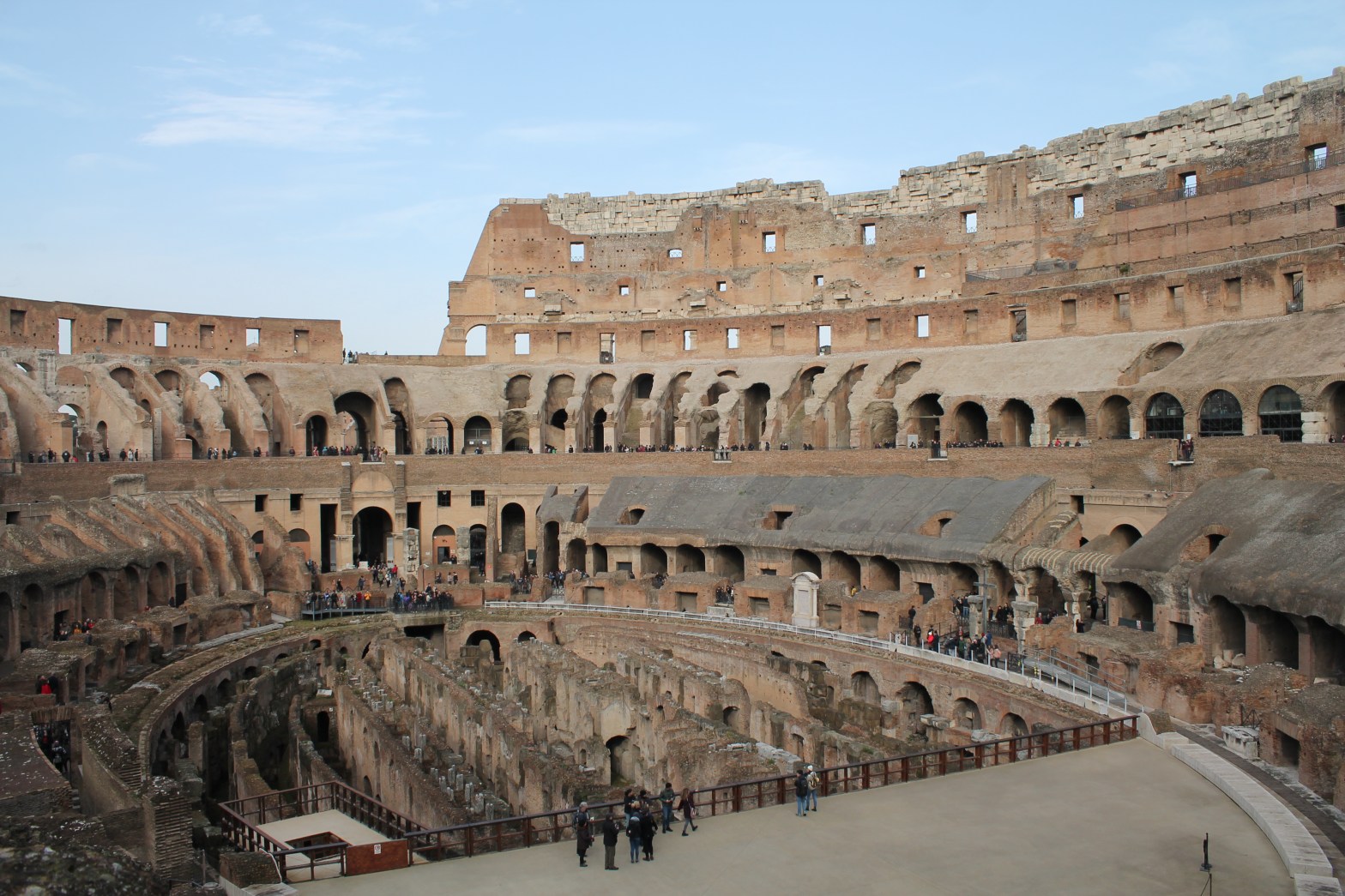
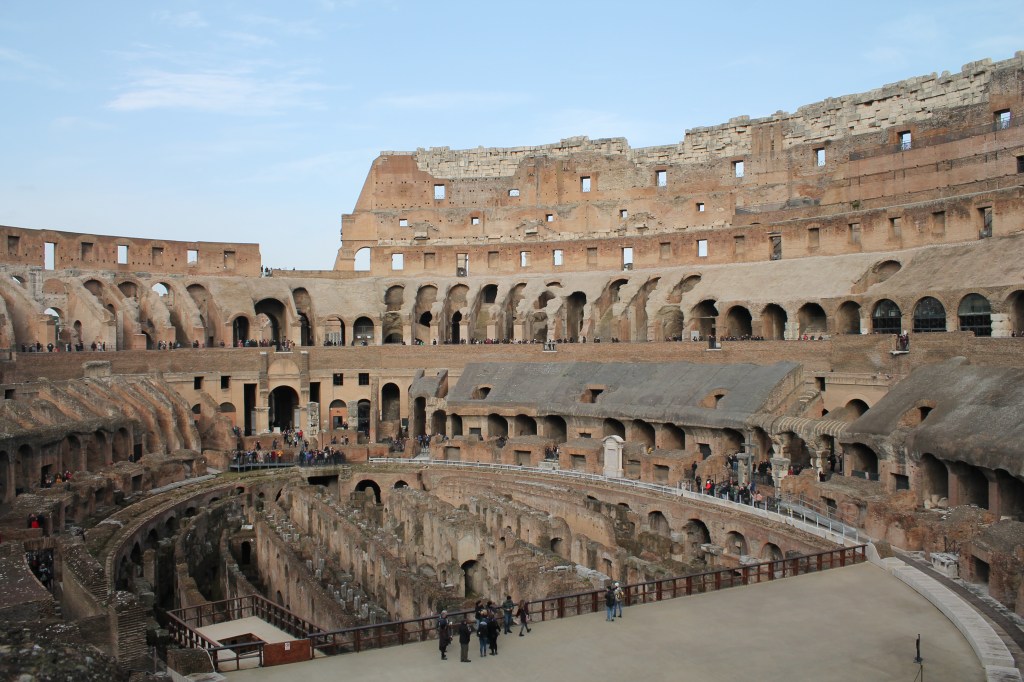
Inside the Roman Colosseum. My photo, taken in 2018.

Rome Pantheon front.jpg
Roman Pantheon. Photo from https://commons.wikimedia.org/wiki/File:Rome_Pantheon_front.jpg, by Roberta Dragan.

However, I did say there are underwater cities. This will lead us to part two.

2- Sunken cities

The planet is hardly static, and cities built around the coastline are sometimes prone to disappearing. This is caused, most generally, by earthquakes, which may change the coastline and allow for water level rises; by the natural rising and falling of seawater levels through the centuries (there can be rather significant differences!); or by other natural phenomena, such as storm surges, coastal floods and wave action. Therefore, a bit all over the world, you have plenty of examples of cities which, for one reason or another, now lie in the depths of the sea and the ocean. Some have been the object of archaeological works, others have not. Some can even be visited by scuba divers. Pictures of these cities are always stunning to see.

Was Roman concrete used in all of them? No. Although it is a lot more durable underwater than many of its modern derivates, fact is that underwater cities have been found not only all around the world (thus, in places that had no access to this concrete and never even dreamed it existed), but also that were built (and likely sunken) long before Roman concrete was invented, or long after it had stopped being used. Some examples:

  • Palovpetri, modern-day Greece. This city was inhabited between the 3rd millenia BCE and the middle of the second millenia; on the turn to the first millenia, it would have been sunken by several earthquakes.
  • Herakleion, in modern-day Egypt. This used to be an important trading harbour for the region, and it is mentioned in the writings of Herodotus, who lived in the 5th century BCE; its, in all likelihood, go way further back. Later, during the 2nd century BCE, several of these natural phenomena led to it slowly being overtaken by the sea.
  • Dwarka, modern-day India. Founded before the year of 574 of our time – some of the materials found, according to the Mahabharata Research, are over 7500 years old. They’re unsure why it is underwater, but it is most likely due to sea-level rises or an earthquake – which led to sea-level rises, or a change of the sea-bed.
  • Port Royal, Jamaica. It was founded in 1494, and it suffered an earthquake and tsunami in 1692, never returning to its original state.

These are only five, but there are thousands, from the American Continent to the United Kingdom to China, and you can spend many hours just looking at the beautiful underwater artefacts and structures that have been photographed.

3- How about Atlantis?

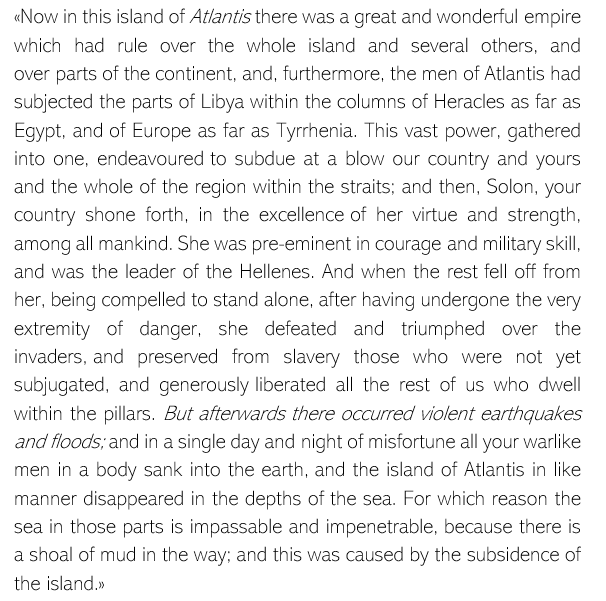
I think that fascination about underwater cities, aside from how beautiful they naturally look, the many archaeological records they can bring us, and the fact that it’s super exciting to suddenly find a 3000 year-old city that no-one even knew existed, is partly derived from the myth of Atlantis. The myth itself, as it is known in the Western world, was first mentioned by Plato, a philosopher who lived in the 5th Century BCE.

Atlantis appears in two different works. The first is Timaeus, a work that takes the shape of a dialogue between a character named Timaeus of Locri, Socrates, Hermocrates and Critias. They’re basically discussing the Ideal State (politically speaking), and Atlantis first appears as an allegory:

The second mention of Atlantis is in Critias, a work of a similar nature, which follows a dialogue between Critias and other characters:

The source proceeds, describing those early years of the foundation of the city, its geography, fountains, fertility, plains, even the Royal Palace; you can read all of that in the original book, which is linked to below. Then their laws and their application, the military, the way its king could act. And it ends thus:

Behold, therefore, Atlantis, a city who had everything and lost everything due to their hybris, their arrogance. It’s really interesting how the source says that things started taking the wrong turn “when the divine portion began to fade away (…) and the human nature got the upper hand”, and that “they appeared glorious and blessed at the very time when they were full of avarice and unrighteous power”.

Much has been said about Atlantis, and much has been made of the debate about whether it is real or an allegory. One of the perspectives is that Atlantis is entirely fictional and an allegory created by Plato as a narrative device. As Harold Tarrant says in a 2007 article, «human beings, it seems, have a natural need for myth», and in particular to explain the «beginnings» and the «ends» of things. As Tarrant goes on to say, people in Antiquity often considered it a myth themselves. This seems demotivating for those who hope for a massive archaeological discovery.

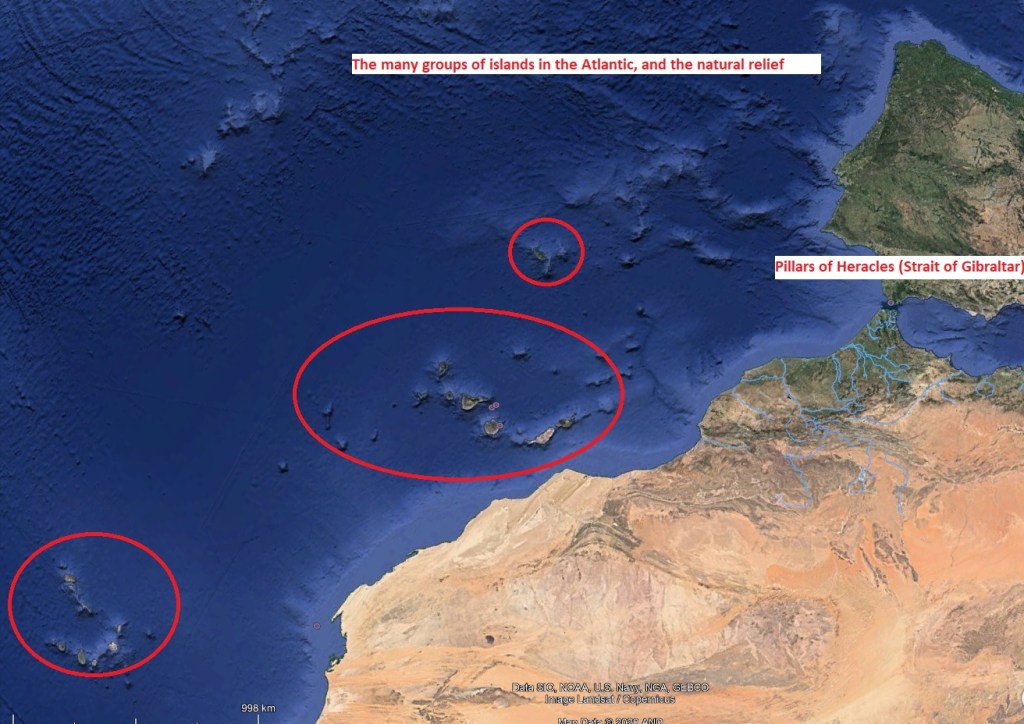
However, there are other perspectives, some which have taken it seriously and have tried to find the island in the Mediterranean and the Atlantic. Some of the most popular are:

  • Knossos, in Crete. The Minoans were a very advanced civilization which suddenly collapsed due to, most likely, a cataclysmic earthquake.
  • Sardinia and Malta, or even Troy.
  • The Azores Islands.
  • The Canary Islands.
  • The Island of Madeira.
  • Cape Verde.

Archaeology often takes the search seriously. Eric Cline says that we’ve already found Atlantis: in 2017, he affirmed that «if there is any kernel of truth underling the myth of Atlantis at all» (notice the doubt, always lingering, always present», it is most likely the Greek Island of Thera, which suffered a volcanic eruption during the 2nd millennium of the BCE.

As you see, there are thousands of hypotheses regarding whether a possible Atlantis might be; there are also many more thousands of scientists who believe it is but a myth, created to explore the idea of a civilisation who grew so arrogant that it was punished by the gods – or to remind us that even the greatest civilisations can suddenly crumble under the influence of factors they cannot control. But the question was directed to me, directly; whether I believe in it. Well, the Spanish have a saying: Yo no creo en brujas, pero que las hay, las hay, which, roughly translated, means: I do not believe in witches; however, that they exist, they do. I personally see Atlantis as a myth, and do not currently believe it was an actual civilisation nor place. I do believe, however, that collective memory of cataclysms (such as the major volcanic eruptions both in Knossos and Thera) may have influenced these thoughts and ideas, and that if Atlantis was not real, the idea behind Atlantis may well have been. It just suffered a slight revamp under Plato’s hands. There is also one last thing: it is very often the case that things that Historians and Archaeologists dismiss as myths (whether cities, people, artifacts… you get the idea!) often end up being proven real by archaeological records. Perhaps Atlantis is just a myth. Perhaps Atlantis was a real location, and we just don’t have the means to find it yet. Who knows? All I say is, never say never.

Hmmmmm… *Insert pensive Odin face*

Sources:

Roman concrete:

Amato, Lucio and C. Gialanella. 2013. “New evidences of the Phlegraean bradyseism in the area of Puteolis harbour”. In Geotechnical Engineering for the Preservation of Monuments and Historic sites, ed. Emilio Bilotta, Alessandro Flora, Stefania Lirer and Carlo Viggiani, 137-43. London: CRC Press / Taylor & Francis Group. Link: http://www.ancientportsantiques.com/wp-content/uploads/Documents/PLACES/ItalyWest/Pozzuoli-Amato2013.pdf

Jackson, Marie, Dalibor Všianský, Gabriele Vola and John Peter Oleson. 2012. “Cement Microstructures and Durability in Ancient Roman Seawater Concretes”. In RILEM Book Series. Vol. 7, 49-76. New York: Springer.

Keay, Simon. 2012. “The port system of Imperial Rome”. In Rome, Portus and the Mediterranean, 33-67. London: The British School at Rome.

Noli, Alberto and Leopoldo Franco. 2009. “The Ancient Ports of Rome: New Insights from Engineers”. Archaeologia Maritima Mediterranea: An International Journal on Underwater Archaeology 6: 189-208.

Oleson, John Peter, Christopher Brandon, E. Gotti, Luca Gottalico, Roberto Cucitore and Robert L. Hohlfelder. 2006. “Reproducing a Roman Maritime structure with Vitruvian pozzolanic concrete”. Journal of Roman Archaeology 19(1): 29-52.
https://www.researchgate.net/publication/288091092_Reproducing_a_Roman_Maritime_structure_with_Vitruvian_pozzolanic_concrete

https://en.wikipedia.org/wiki/Roman_concrete

And, well, me, but my PhD thesis hasn’t been published yet! 😀

Underwater cities:

http://mahabharata-research.com/about%20the%20epic/the%20lost%20city%20of%20dwarka.html

https://en.wikipedia.org/wiki/Dwarka

https://en.wikipedia.org/wiki/Pavlopetri

https://en.wikipedia.org/wiki/Port_Royal

https://en.wikipedia.org/wiki/Heracleion

https://www.newscientist.com/article/mg20427361-700-pavlopetri-greece/

https://www.newscientist.com/article/mg20427361-800-dunwich-uk/

https://www.newscientist.com/round-up/drowned-cities-myths-secrets-of-the-deep/

https://www.newscientist.com/round-up/drowned-cities-myths-secrets-of-the-deep/

https://in.musafir.com/Blog/6-submerged-cities-around-the-world.aspx

http://www.bbc.com/travel/story/20190228-athens-bizarre-underground-phenomenon

https://en.wikipedia.org/wiki/Kaymakli_Underground_City

https://en.wikipedia.org/wiki/Derinkuyu_underground_city

https://www.history.com/news/8-mysterious-underground-cities

https://www.travel-ancient-world-sites.com/Historical-Timeline.html

https://en.wikipedia.org/wiki/Pantheon,_Rome

https://en.wikipedia.org/wiki/Caesarea_Maritima

Atlantis:

Tarrant, Harold. 2007. “Atlantis: Myths, Ancient and Modern.” The European Legacy – Toward New Paradigms, 12(2), 159-172.

Cline, Eric. 2017. “Finding Atlantis?” Three Stones Make a Wall: The Story of Archaeology. (pp. 146-156). PRINCETON; OXFORD: Princeton University Press. 

https://en.wikipedia.org/wiki/Atlantis

https://en.wikipedia.org/wiki/Location_hypotheses_of_Atlantis

Plato, Critias: http://classics.mit.edu/Plato/critias.html

https://en.wikipedia.org/wiki/Critias_(dialogue)

Plato, Timaeus: http://classics.mit.edu/Plato/timaeus.html

https://en.wikipedia.org/wiki/Timaeus_(dialogue)

https://en.wikipedia.org/wiki/Plato

Antónia, Princess of Portugal, Princess of Hohenzollern.

The Portuguese Royal family is often set aside in the larger spectre of the 19th century. Amidst successful reigns such as that of Queen Victoria, the turbulent and often impoverished Portuguese realm may seem relatively unremarkable from afar. But it is not quite so. Portuguese monarchs and their children were well-related through the many royal houses of Europe, valued and appreciated (yes, even by Queen Victoria), and many of them are well-acquainted with, or actually directly related to, important figures at the turn of the century, including some of importance during the outbreak of WWI. One of those figures, which is the one I’m bringing here today, is Infanta Antónia.

File:Antonia de Portugal.jpg
Infanta Antónia of Portugal, at https://commons.wikimedia.org/wiki/File:Antonia_de_Portugal.jpg.

In a previous post, I explained what it means to be an Infanta, but I’ll summarise it here for practicity. Infantas, in Portugal and Spain, are basically the equivalent to a Princess; the only difference is that the holders of the title of “Prince” are the direct heirs, whereas their brothers and sisters are Infantes and Infantas. Thus, in practical matters, Antónia was a Portuguese Princess. She was the great-granddaughter of King João VI, who escaped to Brazil with the rest of the Royal Family during the Napoleonic invasions, the granddaughter of Pedro IV of Portugal (who declared the independence of Brazil, and became the first Emperor of Brazil under the name of Pedro I), and the daughter of Maria II of Portugal, who was born in Brazil, gained her throne through a series of civil wars fought under her name, and was friends with Queen Victoria herself. Not only that, she was also the maternal granddaughter of Maria Leopoldina, Archduchess of Austria and daughter of Francis II, Holy Roman Emperor, and great-granddaughter of Carlota Joaquina, an Infanta of Spain born into the House of Bourbon and descended of Carlos IV of Spain. As you see, if you were to consider her ancestry alone, she had quite an interesting mixture of Royal Houses and high-ranked members.

Antónia’s mother, Maria II, at age II, by Thomas Lawrence (1829). In https://en.wikipedia.org/wiki/Maria_II_of_Portugal#/media/File:Maria_II_Portugal_1829.jpg

Her father, on the other hand, is also an interesting figure. He was the third husband of Maria II, whom she married very young, at the age of 17. Prince Ferdinand’s father, also called Ferdinand, was the son of Francis, the Duke of Saxe-Coburg Saalfeld. Francis, on the other hand, was also the father of Princess Victoria, the Duchess of Kent and Strathearn (thus, mother to future Queen Victoria), King Leopold of Belgium and Ernst I, who succeeded him and became the father of Albert, future Prince Consort of the United Kingdom. Both on her mother and father’s side, Antónia seems connected to many of the major Royal Houses in Europe.

Her father Ferdinand in 1877, by Joseph-Fortuné-Séraphin Layraud. In https://commons.wikimedia.org/wiki/File:Retrato_de_D._Fernando_de_Saxe-Coburgo_e_Gotha,_Joseph-Fourtun%C3%A9_Layraud,_1877_-_Pal%C3%A1cio_Nacional_da_Pena.png

She spent her childhood surrounded by her many siblings, including the future broody and academically-inclined Pedro V and the artistic future Luís I of Portugal. The first great misfortune in her life was, without a doubt, the death of her mother at a very young age, while giving birth to a child which would not survive either. Antónia was 8, and the girl who signed as Antonica, in her own manner of childhood, probably had to grow up far too soon. The events in her life seem to precipitate her to early adult roles: in 1859, her sister-in-law, Queen Stephanie, died at the age of 22; that same year, her older sister, Maria Ana, married prince George of Saxony. That would give Antónia a slightly more prominent role in the Portuguese court, given that she was now the eldest feminine figure in the immediate royal family. The next year, Antónia will see the events leading to her own wedding: at the age of 15, she married Leopold, Prince of Hohenzollern. There was some consolation waiting for her, in that she had the company of her second brother, Luís, up to her new home, and it would be in that new home that she would learn of the loss of three of her brothers, including King Pedro. Her first child, Wilhelm, would not be born until 1864; the second, born the next year, was Ferdinand, who became the first king of Romania and married Princess Marie of Edinburgh. Her grandson, Carol II, was the last king of Romania, abdicating in 1940. Romania was one of the potencies fighting in World War I, siding with the Triple Entente (France, United Kingdom and Russia).

Queen Marie of Romania, a well-known figure for all who are interested in the family lines of Queen Victoria, wrote her memoirs, titled The Story of My life, and she mentions her mother-in-law, Antonia. Her notes on Antonia are quite long, but please take a moment to read them, before we try to scrutinise them a little bit.

File:Queen Mary of Romania 2.jpg
Marie of Romania, by George Grantham Bain, at the Library of Congress (as said by Wikipedia, according to the library, the image has no copyright restrictions).
In https://commons.wikimedia.org/wiki/File:Queen_Mary_of_Romania_2.jpg

«Mamma adored my father-in-law; they got on beautifully together, he was so exceedingly amiable and thoughtful and had such perfect manners; besides, he was highly cultivated, well-read and a very expert art connoisseur. All these qualities my mother appreciated to the full. Altogether Mamma was enchanted with everything, and this aristocratic and yet kindly German family was entirely to her taste. Everybody was simple and friendly, the only one who had any stiffness was Fürstin Antonia, the invalid.» (217)

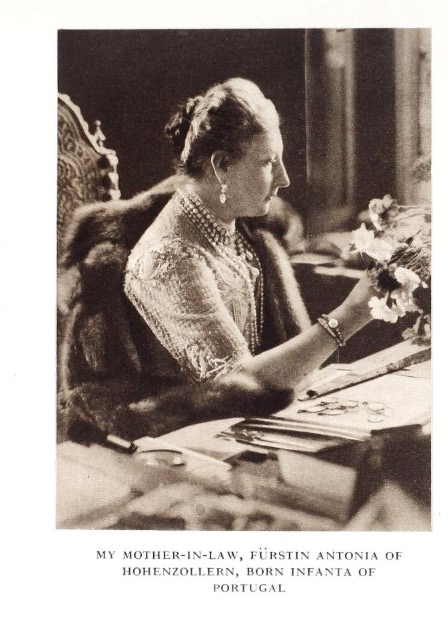
Infanta Antónia, as seen in Marie of Romania’s memoirs. Link in the description.

«Antonia, or Antoinette, had been one of the great beauties of her time; one of those old-fashioned, classic-featured beauties, whom one associates with the crinoline [a type of “cage” to give shape to upper garments]. Her profile was Grecian, her shoulders sloping, her hands long and delicate, her feet very small and useless. But her figure somehow could not fit in with the clothes of the day, there was a disproportion between the bust and the legs. The crinoline was missing. Superbly aristocratic, she moved slowly with a curious swinging of the hips. She loved fine clothes and jewels and, though leading almost an invalid’s life, was always very smartly dressed.

For several years already her health had quite broken down, and I never knew her except as an invalid who mixed only at certain hours with the other members of the family.» (216-217)

And then again, a little further ahead:

«My future mother-in-law’s looks were a great disappointment to me. Having heard that she had been a great beauty, I was all eagerness to see her, but I could not reconcile myself to this pale-faced, pale-lipped, Grecian-nosed woman with the too small bust and too long legs. These proportions can occasionally be beautiful, but in her case, the hips being enormous, there was something about her figure which made you feel positively uncomfortable. Had I been older, I would no doubt have understood how handsome her features still were.

She was most loving and charmingly kind to me, which I later realized must have been somewhat of an effort, because, being an ardent, not to say fanatical Catholic, it was a great distress to her to have a Protestant daughter-in-law.

This, however, had not been purely a question of chance. Roumania was a Greek-Orthodox country, so its people quiet naturally desired that their future king should be of their own faith. It had been one of the conditions accepted by King Carol when he became their sovereign, and knowing that a Catholic princess would never submit to this, he had married a Protestant wife and, willingly or not, Ferdinand was to do the same. Having found a wife to his taste, he did not grudge the sacrifice he was making, although being more strictly religious than his uncle, he was not sure that he was not endangering his soul, especially as his mother was persuaded that he needed the forgiveness of the Church for having overstepped her decrees.

Ferdinand was her favourite son, there was a great affinity of character between the two; besides, as is often the case, distance had minimized his faults and magnified his good qualities. For his sake I was accepted with open arms and with many demonstrations of affection; besides, I was so young and such a confiding little innocent, that I probably disarmed even those whose reasons did not really accept me.» (218)

«And on her side, the Infanta Antonia had inherited some beautiful old Spanish and Portuguese objects from her father, furniture, china, glass, ancient statuettes and some magnificent old silver. She had great taste and had set up her treasures to their best advantage; I would wander about amongst them enjoying their mellowed perfection, though it was many years before I really understood their value or knew how to distinguish their style and periods.

My mother-in-law was an interesting, if not altogether a lovable personality. She was profoundly artistic, an excellent painter, and deeply learned on certain subjects, such as botany, biology and natural history. But in other ways she had remained very narrow and her religion cramped instead of widening her heart, mind and sympathies. She was one of those people who knew no forgiveness of sinners unless it was imposed upon her in the confessional. She was a curious mixture of dignity and childish futility, vain, self-centred, small in her judgment of others; she had no wider sympathies. Life, with its broader human understanding, lay outside her field of comprehension. She lived in a small circle of rules, prejudices and conventions which she considered perfection. It was her love of beauty in general and of flowers in particular that made her congenial to me. But I never dared touch upon general subjects; human conflicts she was unable to grasp, she lived so protected, so out of the world, hedged in by her Church, nursing her delicate health, everybody serving her, caring for her, spoiling her, that she was more like an old and very exigent child than a woman who had lived a real woman’s life, with its temptations, conflicts, doubts, joys, passions and pain.

This I learned little by little as the years went by, for our natures were made to clash, but at that first meeting, she was merely an unexpectedly impressive, middle-aged lady who showered upon me every kindness and attention. I really think she liked me then, but there was also something else in this; I was to be shown off as favourite so as to spite Mädi, her eldest daughter-in-law. Of course then I had no idea of this, or I would have been less flattered by her manifestations of affection, but little by little I was to learn that Fürstin Antonia was a woman who could hate and resent in a way little in keeping with her religious principles, and the unfortunate Mädi [the child of the Queen of Naples, Countess Mathilde, sister of Empress Elisabeth of Austria] was one of those who had known how to awaken her most lasting dislike».

«Later I myself went through the process of being the fallen favourite, when Fürstin Antonia raised Josephine, her third-daughter-in-law [Antónia had a third son, Karl Anton, in 1868], to that short-lived position. How long she occupied it I cannot say, for there was no fourth son to get married, and in later years I went seldom to Sigmaringen, anyhow never for long periods; besides, I had other, deeper troubles to face». (219-221).

She then describes a tea-party in the afternoon of her arrival in Sigmaringen:

«Fürstin Antonia, who never drove with other people, had arrived first by a short cut and received us at a large round table almost breaking beneath its spread of tempting food. The Sigmaringen teas and breakfasts were regular feasts.» (221)

«Punctually, according to the great little Old Lady’s desire, my bridegroom and I appeared in Her Majesty’s [Queen Victoria] inner sanctuary. She was sitting at her writing-table; as usual the air was sweet with that scent of orange flowers peculiar to her rooms. And there indeed upon an easel stands the lovely portrait of Nando’s mother, Antonia, painted at the period of her greatest beauty. Winterhalter had posed her in profile, doing every honour to her faultlessly classical features, to her sloping shoulders and to the slight pout of the lower lip; a superb beauty indeed, with her hair drawn away from her low forehead and arranged in a “chignon” of curls at the back like certain Greek statues. I gazed at it, but did not know in those days how to appreciate that severe type of beauty, preferring the loveliness of Aunt Alix or Cousin Ella. It was because of Antonia’s connexion with the Coburg family that Grandmamma possessed this wonderful portrait of her. Graciously the Queen pointed to the portrait, showed her wee teeth in a very captivating smile and said: “Wunderschön”.» (231)

File:Winterhalter - Infanta Antónia of Portugal.jpg
The stunning Winterhalter in cause, dated 1866. In https://commons.wikimedia.org/wiki/File:Winterhalter_-_Infanta_Ant%C3%B3nia_of_Portugal.jpg

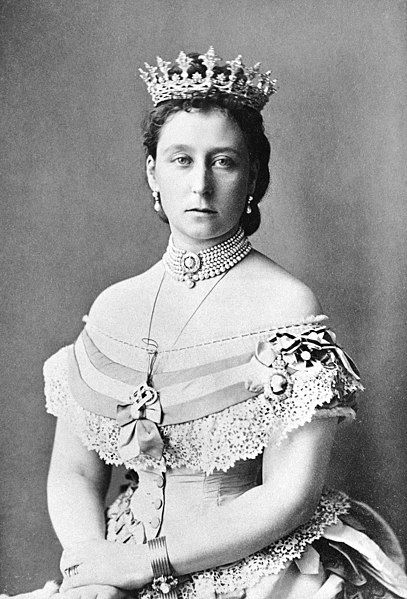
File:Alice, Princess Louis of Hesse.jpg
Princess Alice of the United Kingdom in 1871. In https://commons.wikimedia.org/wiki/File:Alice,_Princess_Louis_of_Hesse.jpg.

Elisabethhesse.gif
Her daughter, born Princess Elisabeth of Hesse and by Rhine, in 1894. In https://commons.wikimedia.org/wiki/File:Elisabethhesse.gif

«Fürstin Antonia was a rather uncomfortable lady. No one except her husband, and in a vaguer way her sons, cared very much for her; she was an egoist and could be exceedingly irritating, but her artistic side and her great love of flowers made a bond between us which stood me in good stead, even when my feeling of irritation took the upper hand. Her narrow Catholicism was trying, and still more her continual belittling of her neighbour and praise of her own virtues. She was not a clever but a talented woman. She never, however, managed to make mischief between Josephine and myself, we were both too staunch and loyal to each other, though life did not bring us much together.» (454)

«On December the 27th of the same year 1913] my mother-in-law died and we all went to Sigmaringen for the funeral. Although his mother had had two slight strokes and had to a certain degree lost her power of speech and thought, this was a great grief to my husband as it was the final breaking up of the old home.

Many royalties flocked together to render the last honours to the woman who had once been a great beauty, and amongst these were the Kaiser and King of Saxony, the latter being a nephew of Fürstin Antonia and closely attached to the Hohenzollern family. His mother, who had died many years before, had been my mother-in-law’s sister, also an Infanta of Portugal, a worthy and very Catholic lady, but who had none of Antonia’s beauty»  (561)

After this rather long passage, let’s sink a little into Marie’s memoirs (you can find the link to the integral version below). There are several key-points she seems to make about Antonia, which, in a way, are conflicting: her great beauty, which Marie, however, did not appreciate until much later; her devotion to Catholicism; and what seems to be a difficult temper.

Looking at the first, you may judge her yourself. Beauty is subjective. Winterhalter’s portrait is as seen below, and there is a photo for you to compare it with. Queen Victoria, who is known to have been a severe judge of feminine beauty, not only owned a Winterhalter of Infanta Antonia, but also thought it would be interesting to show it to her own son upon his arrival, smiling and designing it as “Wonderful”. To a woman born in the dawn of the century as Victoria, Antónia seemed quite a beauty, although Marie herself preferred the beauties of her aunt Alix (probably Princess Alice of the United Kingdom) and her cousin Ella (Alix’s first daughter, born Elisabeth of Hesse). Her beauty is underlined to such an extent that Marie mentions it once again when addressing her funeral: the last honours were rendered to the «woman who had once been a great beauty». Nothing else is said in praise of Antónia by Marie. In several occasions, her tone regarding the Portuguese Infanta can be one of extreme displeasure: she describes her as a «rather uncomfortable lady», and that no one, aside from her husband and «in a vaguer way her sons», truly cared for her; «egoist» and «extremely irritating», «not altogether a lovable personality», «very narrow», «a curious mixture of dignity and childish futility, vain, self-centred, small in her judgement of others», a woman of «prejudice and conventions which she considered perfection», who «lived so overprotected, so out of the world», with everyone «serving her, caring for her, spoiling her»; all in all, «an old and very exigent child». From a notion of no one truly liking her, she goes on to say that people cared for her and even spoiled her; of course, a person being spoiled has nothing to do with their respective likeability, but her son Ferdinand cried deeply at her funeral, something which, according to Marie, was due to Antónia being his last tie to Sigmarigen. Nonetheless, earlier she had said he was her favourite son, and there was a «great degree of affinity» between the two. Could Marie’s description and general view of Antónia be influenced by something impossible to control, namely the inevitable gap between different generations? At one point, she talks of one of Antónia’s sisters-in-law, “Täntchen”, and says that «both her elderly sisters-in-law exasperated her, Fürstin Antonia as well as Carmen Sylva; I am afraid that she even occasionally called them “humbugs” and was not disinclined to be in sympathy with the younger generation when they allowed themselves to criticize their betters» (532). Marie and Antónia clearly were «meant to clash», as she interestingly says, but she respected her knowledge, her love for History and Art, and was even interested in the collections that she inherited from her father. One of the main sources of clash may well have been, alongside the generation conflict, a religious one: Antonia, being deeply devout, may have struggled to fully accept a daughter-in-law born to the Protestant faith. There’s also the fact that Antonia is described as an invalid, who only joined the family at certain hours. Her illness may have influenced her apparently difficult personality. It is interesting to read that she never drove around with anyone. There’s no explanation as to why, but she surely seems punctual, as she arrived before anyone else.

Marie’s image of Antónia very much resembles one of a spoiled, very sheltered child, and if we go back to her childhood, we may wonder how much it influenced her character in later life. Having lost her mother at such a young age, being one of the youngest children (and youngest girl) of the Royal Couple, would it not be natural for Antónia to be over-protected, and even a little spoiled, by the remaining members of her family? Her mother, Maria II, lost her own mother Leopoldina at a very young age and through the same reason (death in childbirth), and there is a certain similarity between the life of the young princess and that of her mother. And if Marie states that Antónia seemed as if she had never lived the life of a woman, the fact is that Antónia married at a very young age, leaving her childhood home to a strange land, bearing her first child about four years later. The memory she left in Portuguese Chronicle and Historiography seems far more pleasant. Antónia did return to Portugal in 1887, after becoming a widow, and had a seemingly pleasant reception; while she lived in Sigmarigen, and according to the Historical Dictionary, she would have given orders to her servants to know the names of the Portuguese people who passed the region and wished to see them, talk to them and hear of Portugal, talking to them in Portuguese. This may be a way of Chronicles enhancing her virtues as a patriotic woman, and the fact is that she lived far longer in Sigmaringen than in Portugal; however, somehow, she wished to come back and see the place where she was born, and it would not be a surprise that Antónia, born Antónia Maria Fernanda Micaela Gabriela Rafaela Francisca de Assis Ana Gonzaga Silvina Júlia Augusta, would have missed the comfort of her native land, which she had to leave so young. Perhaps Marie failed to see, or simply did not know, the inner feelings of Antónia, who may well have been marked by the events of her life up to the age of fifteen. In her letters to King Luís, her brother, she wrote about her Saudades, a word I shall not translate, but related to a feeling of loss and of missing something or someone.

«The saudades I have of you, of everything that is Portuguese, increase with time; this is the homeland we have, and how good the Portuguese are.»

  • «I hope the Portuguese, for whom I feel so many saudades, still think a little of me.» Bragança, D. Antónia de (1887c): Carta para D. Luís, Sigmaringen, 1 de Julho. IANTT, Casa Real, 16/310/59.
  • «Do not think that, because I am very German, I am less Portuguese; one could not like one’s homeland more than I do.» Bragança, D. Antónia de (1887d): Carta para D. Luís, Sigmaringen, 10 de Julho. IANTT, Casa Real, 16/310/60.
  • «I have suffered plenty of a sort of ice which exists in German hearts that never have the same charity as the heart of my good and dear Portuguese, I often fear how dedicated I feel to my country, only now, after having been there, do I know how to properly appreciate the Portuguese, when I left Portugal I Was very young, almost a child, everything would come out of me, I did not think I could find the years worse in my new land, everything seemed to be smiling, until the death of my poor siblings, since then I started to suffer on my own, no one in my new land knew my family, they were foreign to all, if I were sad I was showing my feelings too much, if I laughed I was making too much noise, and thus my character was shaped, and at 19 I had felt more harshness from life than many feel in their whole lives» (Antónia wrote without final periods and with commas). Bragança, D. Antónia de (1885b): Carta para D. Luís, Sigmaringen, 28 de Novembro. IANTT, Casa Real, 16/310/46.

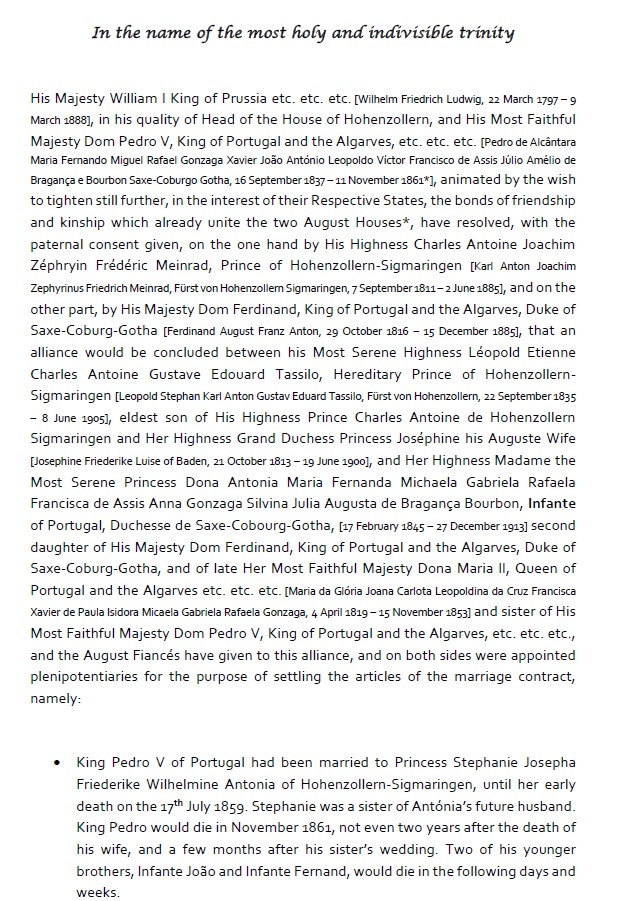
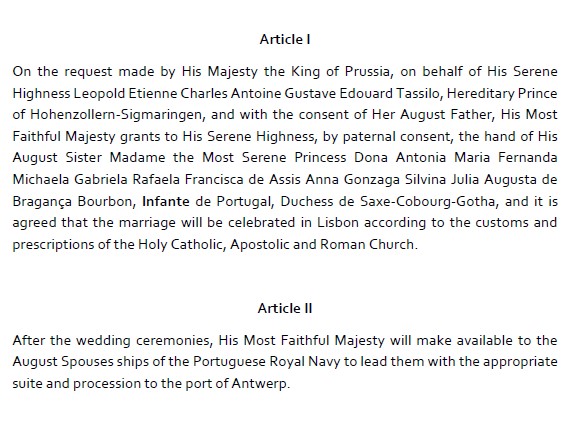
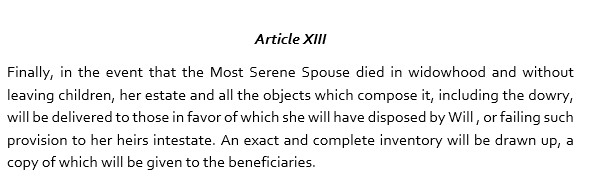
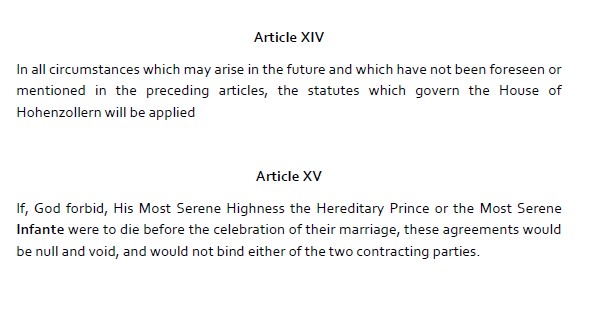
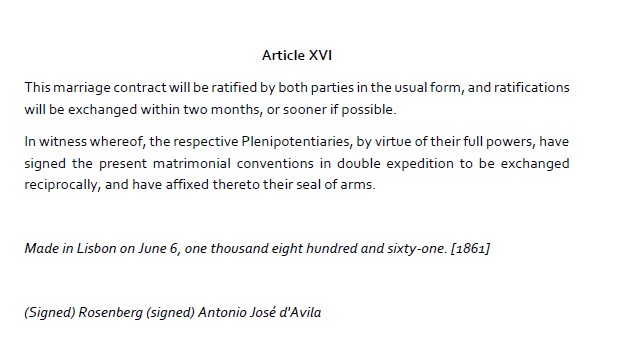
These are my translations of excerpts of letters which you may find on Wikipedia. There is more on her in the Portuguese archives, although you’d have to personally visit to read most of them: several letters from her to Luís, the registry of her christening, her renunciation to succession rights towards the Portuguese throne, several documents regarding her marriage contract. In these excerpts, you can see that Antónia herself complains of the new culture into which she is inserted, one she struggles to adapt to. Antónia seems to feel that her new court wants her to be emotionless, that she is not allowed to show sadness nor happiness to great extents. This was a particular struggle upon the death of her older siblings, which seems to have emotionally processed on her own. Of course, these are memoirs, thoughts of an older Antónia regarding her youth, just as Marie of Romania’s memoirs do the same thing. Memoirs are bound to be inaccurate, at times. But it would seem that somewhere towards the middle of her life, Antónia was still extremely homesick, to such an extent she was glad to visit and see her older brother one last time. From these words, it seems highly unlikely that Antónia was as Marie described her: she seems quite the opposite, an extremely sentimental woman who was taught how to be restrained, and probably became increasingly attached to the memories of her former country and the saudades she had of her family. Whereas she left Portugal rather hopeful for her new life, her hope was soon transformed. It is interesting how Marie, who left her own home to marry a foreign prince and did very much the same as Antónia, struggled to understand the circumstances which may have shaped her mother-in-law. You have their words, their images. I shall leave Antónia’s character to your own judgement.

I have one last piece to show you, one which I’ve seen myself and directly translated from the original. This is a letter that Antónia wrote to her mother, at a very young age. It was not uncommon for  Royalty to send little notes to one another even while living in the same house, and Antónia writes thus:

«22 April

My dear Mama,

I hope you are well. Yesterday I removed a tooth, I did not scream a thing. I have a beautiful rosebush. Ratão and Gugu [I do not know who she is referencing] send their best regards to Mama. Goodbye my dear Mama.

Antonica.

For Mama.»

Infanta Antónia of Portugal (1845-1913).jpg
Infanta Antónia, 1870. In https://commons.wikimedia.org/wiki/File:Infanta_Ant%C3%B3nia_of_Portugal_(1845-1913).jpg

Some sources:

Anne with an E – (The lack of) Red-haired heroines in classic books

There’s been plenty of talk in social network and the media about the cancelling of Netflix show Anne with an E. This is a show based on the works of Lucy Maud Montgomery, which follow the life of Anne, a red-haired orphan who accidentally ends up at the Cuthbert household after Matthew and Marilla Cuthbert, siblings, decided to adopt a boy to help Matthew with the farm work. The first book of the series, Anne of Green Gables, was released in 1908, and its popularity has made it into one of those classics that everyone hears about, at one point or another of their lives. Proof of this popularity is that there have been several adaptations before Anne with an E came to life,

There are several elements that distinguish Anne in the universe of literary heroines and make her one of the most well-known and recognisable, but the most evident of them might well be her trademark red hair. I’m an avid reader of those so-called Classics and enjoy them very much, but fact is that there are not many red-haired heroines. Especially not in 19th and early 20th century scenarios. When we first meet Anne, the author gives us a description:

«A child of about eleven, garbed in a very short, very tight, very ugly dress of yellowish-gray wincey. She wore a faded brown sailor hat and beneath the hat, extending down her back, were two braids of very thick, decidedly red hair. Her face was small, white and thin, also much freckled; her mouth was large and so were her eyes, which looked green in some lights and moods and gray in others.» (Page 15-16)

This particular shade of red hair does change through the course of the novel, however:

«’Your complexion is just as fair as Ruby’s,’ said Diana earnestly, ‘and your hair is ever so much darker than it used to be before you cut it.’

‘Oh, do you really think so?’ exclaimed Anne, flushing sensitively with delight. ‘I’ve sometimes thought it was myself – but I never dared to ask anyone for fear she would tell me it wasn’t. Do you think it could be called auburn now, Diana?’

‘Yes, and I think it is real pretty,’ said Diana, looking admiringly at the short, silky curls that clustered over Anne’s head and were held in place by a very jaunty black velvet ribbon and bow.» (277-278)

«I laugh a little now sometimes when I think what a worry my hair used to be to me – but I don’t laugh MUCH, because it was a very real trouble then. I did suffer terribly over my hair and my freckles. My freckles are really gone; and people are nice enough to tell me my hair is auburn now – all but Josie Pye. She informed me yesterday that she really thought it was redder than ever, or at least my black dress made it look redder, and she asked me if people who had red hair ever got used to having it.» (373-374)

There are countless references to Anne’s red hair throughout the novel. At first, it seems to be seen as something undesirable, especially by Anne herself. Her relationship with Mrs. Lynde even improves when she tells her a story of a girl who had red hair which darkened to auburn as she grew up. It is the trigger for her entire relationship with Gilbert Blythe, because he calls her Carrots, which she finds very offensive. Even at the end, Anne finds contentment with her situation, but that contentment is partly related to the fact that her hair has, in fact, darkened.

Her joy when Diana acknowledges it makes it evident. Anne sets a huge importance in her physical appearance in the first book. She wants to be pretty, and has a very fixed idea of what being pretty is. Darker hair – or any colour but red, really – and no freckles, and, if possible, all that together with pretty puff-sleeve dresses. Anne is shown as vain throughout at least the first half of Anne of Green Gables, and sets a huge importance in how she looks like. Everyone will say “But that is shallow, that is so wrong!” Well, “let the one who has never sinned throw the first stone”, and all of that. Everyone is different, but many of us did care immensely about our appearance during those awkward teenage years, and even afterwards. The fact that Anne is vain is what makes her so real. You cannot have a hero without flaws. Well, you can, but it’s highly doubtful that people can relate to them much.

But back to her red hair. Most of 19th-20th century heroines, whether good or bad, sweet and delicate or strong and fierce, do not have red hair. Let’s look at a few examples. Les Misérables, for example, written in the 19th century by Victor Hugo. The driving character of it all is, to me, Jéan Valjean, but there are four female characters who play an important role: Fantine, Cosette, Éponine and Madame Thénardier. How are they presented?

Fantine is a blonde. This is actually presented as one of her defining characteristics, as she is known as The Blonde.

«Fantine was beautiful (…). She was a lovely blonde, with fine teeth. She had gold and pearls for her dowry; but her gold was on her head, and her pearls were in her mouth.» (213-214)

«As for Fantine, she was a joy to behold. Her splendid teeth had evidently received an office from God, – laughter. She preferred to carry her little hat of sewed straw, with its long white strings, in her hand rather than on her head. Her thick blond hair, which was inclined to wave, and which easily uncoiled, and which it was necessary to fasten up incessantly, seemed made for the flight of Galatea under the willows.» (219)

Cosette, her daughter, is a light brunette.

«She had wonderful brown hair, shaded with threads of gold, a brow that seemed made of marble, cheeks that seemed of rose-leaf, a pale flush, an agitated whiteness, an exquisite mouth, whence smiles darted like sunbeams, and words like music, a head such as Raphael would have given to Mary, set upon a neck that Jean Goujon would have attributed to a Venus.» (1195)

Éponine’s hair colour is not presented to us when she gets a longer description. But when Fantine and Cosette first meet Thénardier and her children, we know they both have brown hair.

«The two children, who were dressed prettily and with some elegance, were radiant with pleasure; one would have said that they were two roses amid old iron; their eyes were a triumph; their fresh cheeks were full of laughter. One had chestnut hair; the other, brown.» (253)

Thénardier, on the other hand, is a ginger. Hair colour is something that can go a little amiss in translation.

«This Madame Thenardier was a sandy-complexioned woman, thin and angular – the type of soldier’s wife in all its unpleasantness; and what was odd, with a languishing air, which she owed to her perusal of romances.» (259; in the original, the quote is – Cette madame Thénardier était une femme rousse, charnue, anguleuse. Rousse usually translates as red-haired.)

These four women are all representative of human suffering, in their own way, but the connotations of their personalities and ending vary. Fantine, the Blonde, was a devoted mother with the misfortune of falling in love with a man who abandoned her. She ends up selling her teeth, her hair, and entering the world of prostitution. She is presented as a type of fallen angel, a woman who was genuinely good and caring and suffered all types of misfortune because of Mankind. Éponine, the brunette, started her life in a fortunate position, but thanks to her father’s actions, she ends up in misery and poverty, rejected by the man she falls in love with and protects. Cosette seems like a classical “good angel of the family” type of character; her existence moves the plot along, but not her actions, and her ultimate destiny is to be happy and make Marius happy in return; a chestnut brown-haired lady. Thénardier, the most morally flawed of the lot, is red-haired.

Light and dark hair are a constant in 19th century literature and each have their particular connotations and glowing periods. Anne Martin-Fugier, in Philippe Ariés and Georges Duby’s edition of History of Private Life, lightly touches the subject, stating that during the height of the Romantic Period, brunettes are preferred (238); later in the century, judging by other 19th century authors, it seems blondes make a strong comeback. But literary heroines and red-hair mingle very little. Another such example is seen in the Count of Monte-Cristo, with the three main figures: Mercédes, Valentine and Haydée. I’m skipping Eugenie Danglars, as she is not as relevant as the others in the life of Édmond Dantes.

Mercedes, the Catalan brunette:

«A young and beautiful girl, with hair as black as jet, her eyes as velvety as the gazelle’s, was leaning with her back against the wainscot, rubbing in her slender delicately moulded fingers a bunch of heath blossoms, the flowers of which she was picking off and strewing on the floor; her arms, bare to the elbow, brown, and modelled after those of the Arlesian Venus, moved with a kind of restless impatience, and she tapped the earth with her arched and supple foot, so as to display the pure and full shape of her well-turned leg, in its red cotton, gray and blue clocked, stocking.» (8)

Valentine de Villefort, the pale chestnut :

«Valentine, whom we have in the rapid march of our narrative presented to our readers without formally introducing her, was a tall and graceful girl of nineteen, with bright chestnut hair, deep blue eyes, and that reposeful air of quiet distinction which characterized her mother». She is described as having the «gracefulness of a swan.» (216)

Haidée, a Greek beauty:

«Tilted on one side of her head she had a small cap of gold-colored silk, embroidered with pearls; while on the other a purple rose mingled its glowing colors with the luxuriant masses of her hair, of which the blackness was so intense that it was tinged with blue.» (207)

In this case, both of the main hero’s love interests are black-haired women, and both are presented as good women, although Mércedes is a victim of the plot against her beloved, just as much as he is. Her decision to marry Férnand Mondego, not long after Édmond disappeared, ultimately determined that she was not to keep her wealth and status, but the author does not punish her too hard for this choice. She is a victim of Fate, to an extent, but she is always presented as a good woman who loved Édmond and who loved her son, and who suffered misfortune in her own right. Her ultimate fate of being an impoverished mother who worries about her absent son is dramatic, but in all extent, honourable.

Black-haired heroines, however, are not always kept in the most favourable light. There are two blatant examples: Anna Karenina and Scarlett O’Hara.

Anna:

«She took off her kerchief and her hat, and catching it in a lock of her black hair, which was a mass of curls, she tossed her head and shook her hair down.» (146)

«On her head, among her black hair – her own, with no false additions – was a little wreath of pansies, and a bouquet of the same in the black ribbon of her sash among white lace. Her coiffure was not striking. All that was noticeable was the little wilful tendrils of her curly hair that would always break free about her neck and temples.» (172)

Anna’s dark hair is especially striking when compared to that of Kitty Shtcherbatskaya:

«When he thought of her, he could call up a vivid picture of her to himself, especially the charm of that little fair head, so freely set on the shapely girlish shoulders, and so full of childish brightness and good humour.» (64)

Anna and Kitty are often compared. Even though Anna is the main character, Kitty is, to an extent, her counterpart, and the most well-developed female character in Anna Karenina next to Anna herself. Anna’s fate is the one so well-known: she suicides in the end of the book. Kitty, on the other hand, is the good-natured, although naïve and often childish heroine, who endures a growth process and ends up finding happiness with her husband, Levin. Anna enters a spiral into her ultimate downfall, and we are invited to question ourselves about this character, her feelings and her motivations, whether she had been truly good from the start, whether she kept her good feelings, where did it all go so wrong.

This is not the case for Scarlett O’Hara. Unlike Anna, Scarlett never has deep moral reflections. In fact, Scarlett doesn’t have deep reflections of any kind. She just lives. It is interesting that while the book opens with nothing other than Scarlett O’Hara’s physical description, there is nothing to mention her hair colour until much later on:

‘Scarlett O’Hara was not beautiful, but men seldom realized it when caught by her charm as the Tarleton twins were. In her face were too sharply blended the delicate features of her mother, a Coast aristocrat of French descent, and the heavy ones of her florid Irish father. But it was an arresting face, pointed of chin, square of jaw. Her eyes were pale green without a touch of hazel, starred with bristly black lashes and slightly tilted at the ends. Above them, her thick black brows slanted upward, cutting a startling oblique line in her magnolia-white skin – that skin so prized by Southern women and so carefully guarded with bonnets, veils and mittens against hot Georgia suns.» (1)

«But for all the modesty of her spreading skirts, the demureness of hair netted smoothly into a chignon and the quietness of small white hands folded in her lap, her true self was poorly concealed.»

We only get the confirmation of Scarlett’s black hair later on:

«If only she were Scarlett O’Hara again, out there on the floor in an apple-green dress with dark-green velvet ribbons dangling from her bosom and tuberoses in her black hair – she’d lead that reel.» (77)

«If only Rhett had not been so silly and burned the false curls she bought to augment her knot of Indian-straight hair from the rear of these little hats!» (228)

This is a trait she will share with her favourite daughter, born Eugenie Victoria, better known as Bonnie:

«People were always in their front yards or on their porches at sunset and, as Bonnie was such a friendly, pretty child, with her tangle of black curls and her bright blue eyes, few could resist talking to her.» (32)

Curiously enough, Gone with the Wind is one of the books with greater hair-colour variety where classic books are regarded, both in the feminine and the masculine department. There are the Tarleton twins, «with sunburned faces and deep auburn hair» (3), Ashley Wilkes («his drowsy gray eyes wide with a smile and the sun so bright on his blond hair that it seemed like a cap of shining silver», 10; «There was no one there so handsome, thought Scarlett, as she marked how graceful was his negligent pose and how the sun gleamed on his gold hair and mustache», 45), Gerald O’Hara («he was sixty years old and his crisp curly hair was silver-white», 13); and, of course, the timeless Rhett Butler («his hair was jet black, and his black mustache was small and closely clipped, almost foreign looking compared with the dashing, swooping mustaches of the cavalrymen near by», 75).

In the ladies’ department, there is Ellen O’Hara, with black hair described as «luxuriant» (15), and then all the red-haired Tarleton ladies: Beatrice Tarleton («frail, fine-boned, so white of skin that her flaming hair seemed to have drawn all the color from her face into its vital burnished mass; 28) and her four girls («all shades of red hair were represented beneath these hats, Hetty’s plain red hair, Camilla’s strawberry blonde, Randa’s coppery auburn and small Betsy’s carrot top, 30); then, a few blondes, like India Wilkes («Poor India! It would be bad enough to have pale hair and eyelashes and a jutting chin that meant a stubborn disposition, without being twenty years old and an old maid in the bargain», 37. Thanks, Scarlett.), Scarlett’s youngest sister Carreen «The day came when his pale blue eyes, perfectly cognizant of his surroundings, fell upon Carreen sitting beside him, telling her rosary beads, the morning sun shining through her fair hair», 143). There’s also Belle Watling, the «woman with red hair», «flaming hair», the town’s “bad woman”, as Scarlett says, who ends up being better than so many by donating money for war efforts, protecting the men of Atlanta during their scrapes, and worrying about Melly’s good name, and is defended by Melly herself.

But the most striking physical description of a female character, aside from Scarlett O’Hara, goes to Melanie.

«She was a tiny, frailly built girl, who gave the appearance of a child masquerading in her mother’s enormous hoop skirts – an illusion that was heightened by the shy, almost frightened look in her too large brown eyes. She had a cloud of curly dark hair which was so sternly repressed beneath its net that no vagrant tendrils escaped, and this dark mass, with tis long widow’s peak, accentuated the heart shape of her face. Too wide across the cheek bones, too pointed at the chin, it was a sweet, timid face but a plain one, and she had no feminine tricks of allure to make observers forget its plainness.» (39).

The two main female characters of Gone with the Wind  both have dark hair. Melly has brown, Scarlett has black. The few blondes are secondary, albeit important characters, and the big difference here is the amount of red-haired people, and the fact that red hair always has a positive connotation, even in Belle Wattling’s case: while Scarlett and many others are dedicated to judging her under false pretence of morality, Belle, who is perceived as a fallen woman by that 19th century society, shows her truly good nature, one which is acknowledged by popular black-haired rake Rhett Buttler, of whom she, in all likelihood, has a son.

And yet, throughout all these books, with more or less variety, there is not a single red-haired heroine. Many of them don’t even have women as main characters, but as counterparts to a hero. Those who do have female heroines as leads, such as Anna Karenina, don’t give them red hair. And yet, there is an absurd amount of time and dedication to physical description of characters in these books, and hair is one of the most frequently found details. Why not red?

There’s a blatant difference between literature and art in this regard. A quick search in Wikipedia (link below!) will show you the immense amount of prejudice against red-haired people through time, especially during the Middle Ages. The article gives detail, for instance, of Montague Summers, who translated the Malleus Maleficarum, a book regarding witchcraft published in 1487, which states that «those whose hair is red, of a certain peculiar shade, are unmistakably vampires»; red hair was associated to witchcraft and the supernatural. Even today, there is bullying, even though we have so many examples of popular, beautiful red-haired (natural or dyed, doesn’t matter!), such as Emma Stone, Amy Adams, Isla Fisher, Juliane Moore, and, of course, Amybeth McNulty, the star of Anne with an E. It seems that this vibrant, wonderful colour, which has always drawn so much attraction, has also brought a lot of problems to the bearers.

But not all is bad. If literature – and writers of books on Witchcraft Prevention – were not the biggest fans, artistic movements seem to have felt otherwise. Paintings represent life, imagery occurring before us, and many, many painters felt attracted to red-hair hues. This was particularly true in that very same 19th century in which red-haired heroines were cast aside. Look, for instance, at John William Waterhouse’s Lady of Shalott (1888), or Edmund Leighton’s The Accolade (1901).

There were others, long before them, who saw the beauty of red hair, especially Renaissance painters. Red was all en-vogue. However, back then, it was all about the golden red, the strawberry blonde, as seen in Botticelli’s many paintings. Even through the efforts of these painters, it would take many more years for red hair to be seen as fashionable. But if Venus herself is red-haired, how can anyone counter that?

Lucy Maud Montgomery’s heroine is singular in many ways, which I would prefer leaving to a later post, as Anne’s personality and evolution deserves an article of its own. But one thing is striking: following her first few adventures at Green Gables, Mrs. Rachel states that «her temper matches her hair» (85). Anne’s red hair is more than just a physical characteristic. The colour seems to have been purposefully chosen to reflect her inner self. And yet, as the book progresses, this fiery, extroverted Anne transforms into a quiet, introspective and far quieter person, but her hair remains just as red. She proves that one should not judge a book by its cover – on these grounds, Scarlett O’Hara should have the brightest red of all. Anne with an E has not followed the book to its every detail, and most good adaptations don’t – that’s why it’s called an adaptation. I will confess myself a book purist, whose greatest dream is usually for a series or film to follow each microscopic detail of the original work, even though this is obviously impossible. However, this did not bother me in the slightest while watching Anne with an E. That’s when I realised that perhaps the issue with adaptation detours is not that they’ve changed the original work, but the way in which they change it. Anne with an E changed it in the best possible way. Anne’s growth as a person is easy to observe, but her sunny and lively personality remains with her throughout. There’s nothing wrong with being an introvert, especially when the world is placing so much pressure on people to be extroverted, whether they enjoy it or not. But I find this creative option particularly charming. This show portrays a time period in which women are often told to keep quiet, be silent, keep their opinions to themselves, problems that have not completely disappeared in the 21st century, but the show gave Anne, especially older Anne, a voice. She wants to be herself and to be heard, she wants to enjoy life and her friends and family, and she doesn’t want to follow a pattern of being a woman that society has imposed to her. Being a woman – being a person, doesn’t have a pattern. Just like a hair colour does not say who you are. I’ve had every hair colour in the spectre, including bright red hair. I was not a better nor worse person for it. But one thing is certain. Red hair is awesome, and red-haired heroines are still heavily underrepresented. Cheers to the hope of more in the future.

Saluete

Important links: I’m listing all the books below in PDF, Free Access, as an incentive to reading.

Anne of Green Gables: https://www.planetebook.com/free-ebooks/anne-of-green-gables.pdf

Les Misérables: https://www.planetebook.com/free-ebooks/les-miserables.pdf

Anna Karenina: https://planetpdf.com/planetpdf/pdfs/free_ebooks/Anna_Karenina_NT.pdf

The Count of Monte Cristo:

http://msdl.cs.mcgill.ca/people/tfeng/books/The%20Count%20of%20Monte%20Cristo.pdf

Gone with the Wind:

http://biblioteka.kijowski.pl/mitchell%20margaret/gone%20with%20the%20wind.pdf

Wikipedia article on red hair:

https://en.wikipedia.org/wiki/Red_hair

Other interesting bibliography (give it a go if you have the time and find it):

A History of Private Life, ed. Philippe Ariès and Georges Duby. I used Volume 4 of the Portuguese translation, published in 1990.
Queen Victoria and her children

I don’t know about you, but I’ve always had an interest in family history and genealogy. So a couple of years ago, I started doing my personal research. So far, I’ve tracked my family’s line up to the late 1700s (in some cases, all the way back to 1640). These ancestors of mine were living, working and breathing in the 18th and 19th centuries. They were living in times of great changes in the world, and coexisted with many well-known figures that shaped the paths of History and brought us where we are today. The likelihood of any of those figures ever having heard of the mere existence of my ancestors, many of which lived in a small rural area in the North of Portugal, is practically inexistent. But my ancestors probably heard of a few of them. I doubt the name of Queen Victoria was never pronounced by any of them, especially considering the connections between Portuguese and British History.

Their lives couldn’t be more different, separated by their condition and living space. But while I can visit Queen Victoria’s ancestral households and they could most certainly not, they have an advantage: there is no time to separate them. Their family history was developing at the same time: they were getting married and having their children simultaneously. I have an ancestor born around 1803; Queen Victoria was born in 1819. When Her Majesty was born, my ancestor was already sixteen years old.

I find the overall family history of Queen Victoria an oddity in the general course of the 19th century. I’m not going to debate her married life in this piece, because that is a whole other article in itself. Her motherhood, however… there are many of her remarks circulating on-line, about how she disliked children, how difficult of a mother she was. And yet, she went on to have nine children. This goes far beyond the heir and the spare. She had five girls and four boys. Most of my family members, even back in the 19th century, did not have more than 4-5, and some died in childhood. All of Queen Victoria’s children lived to adulthood, and every single one was married. She was nearly 21 when she married, whereas my ancestors, surprisingly or not, usually married a little later, in their mid-late 20s or even 30s; the number of fertile years is slightly reduced.

Coincidentally, my ancestors, overall, also seem to birth more girls than boys. They would go on to have very similar lives to those of their parents, but Queen Victoria’s children all had their own path, however sheltered. Here are their names:

Victoria Adelaide Mary Louisa. She received the title of Princess Royal (attributed to the eldest child of a sovereign and currently held by HRH the Princess Anne). Born on the 21st November 1840, she died on the 5th August 1901, at the age of 60, in what is currently German territory; she married the Prussian Emperor Frederick (Friedrich) III and had 8 children (four girls, four boys).

Albert Edward. Later King Edward VII, had a relatively short reign (22nd January 1901 to 6th May 1910). He was born on the 9th November 1841, less than a year after his sister, and died on the 6th May 1910, at the age of 68; his wife was the popular Queen Alexandra, born Princess Alexandra of Denmark. They had six children (three girls and three boys).

Alice Maud Mary. Born on the 25th April 1843 (the day of a Portuguese revolution, occurred more than two-hundred years later), she died on the 14th December 1878 at the young age of 35, becoming the first of the Queen’s children to die. She married Louis (Ludwig) IV, Grand Duke of Hesse and by Rhine, and had seven children (five girls and two boys). She died in what is currently German territory as well. The difference between Alice and Albert Edward is of little more than a year.

Alfred Ernest Albert. Born on the 6th August 1844, he died on the 30th July 1900, also in modern-day Germany, at the age of 55. He married Grand Duchess Maria Alexandrovna of Russia (they named a biscuit after her!), and they had five children (a single son and four daughters, one of which Queen Marie of Romania, daughter-in-law to Princess Antónia of Portugal; couldn’t resist adding this detail).

Helena Augusta Victoria, born on the 25th May 1846; she died in the United Kingdom at the age of 77, on the 9th June 1923. Married to Prince Christian of Schleswig-Holstein (Frederick Christian), she had four children, two girls, two boys.

Louisa Carolina Alberta, better-known as Louise, born on the 18th March 1848; she died in the United Kingdom at the age of 91, on the 3rd December of 1939. She married John, Marquess of Lorn and heir to the Duchy of Argyll. They had no children together. I abstain from comments to Louise’s alleged pregnancy prior to her marriage, as there is nothing proven in regard to its existence or the contrary.

Arthur William Patrick Albert, born on the 1st May 1850; he died in the United Kingdom on the 16th January 1942, at the age of 91. He married the Princess Louise Margaret of Prussia, and together they had one son and two daughters.

Leopold George Duncan Albert, born on the 7th April 1853; he died on the 28th March 1884, at the age of 30 in Cannes, France; Prince Leopold was a haemophiliac. He married Princess Helena of Waldeck and Pyrmont and had two children, a girl and a boy. The boy was born postumously.

Beatrice Mary Victoria Feodore, the youngest of all children, born on 14th April 1857; she died in the United Kingdom on the 26th October 1944, at the age of 87. She married prince Henry of Battenberg and had four children, three sons and a daughter; her daughter, Victoria Eugenie, would go on to become Queen of Spain, and the current Royal Family descends from her.

So in terms of birthdates we have:

1840 – 1901 (Vicky, fourth to die, at 60)

1841 – 1910 (Bertie, as he was known in the family, fifth to die, at 68)

1843 – 1878 (Alice, first to die, at 35)

1844 – 1900 (Alfred, third to die, at 55)

1846 – 1923 (Helena, sixth to die, at 77)

1848 – 1939 (Louise, seventh to die, at 91)

1850 – 1942 (Arthur, eighth to die, at 91)

1853 – 1884 (Leopold, second to die, at 30)

1857 – 1944 (Beatrice, last to die, at 87)

Queen Victoria died on the 22nd January 1901, at the age of 81. Hence, three of her children died before she did (Alice, Leopold and Alfred), and one right afterwards (Vicky). It seems that most of her children who went on to have descendants had more girls than boys, with the particular exception of Princess Beatrice; it also seems that the group of the five younger children, with the exception of Leopold, who had haemophilia, lived to older ages than their four oldest siblings.

Another interesting point is that the Princess Royal was already sixteen-going-on-seventeen (ha) when her last sibling was born; Vicky was married on the 25th January 1858, so Beatrice was not even one year old when her sister left for Prussia. Their relationship must have been very different from that of the group born between 1840 and 1844. Beatrice would grow up aware of the existence of a sister nearly seventeen years her senior, who lived in a country far away. She was closer in age to Vicky’s children than to her own brothers and sisters: Wilhelm II (Kaiser Wilhelm) was born on the 27th January 1859, Charlotte on the 24th July 1860.
A stark contrast to my own family’s reality, with a smaller number of children, although also distanced in years; and whereas many of Queen Victoria’s children ended up spending part of their lives abroad, my own relatives did not usually dislocate themselves (note, usually) more than a few quilometres. A twist of History, a little turn on the right or the left, a little accident of fate and who knows? They may have been practically side-by-side, without ever even knowing.

The Hotel Francfort, but also the Marrare

Today’s post is a lot less philosophical and a lot more actual History.

When we are walking along a city landscape, we often admire its old buildings, isn’t it? We’re walking past and our minds are thinking “Woah, 200 years ago this building was already here. I’m walking someone’s steps and seeing what they must have seen”. If you’re visiting Lisbon, and depending on the time of the year, you’re either thinking that or cursing the decision to walk instead of getting a tram. There’s a reason it’s called the City of Seven Hells Hills, after all (really, don’t come for a walk in Lisbon without comfortable shoes).

This assumption is only natural, since the idea that is sold to us upon a visit to certain locations is their nearly timeless existence. But that isn’t usually that linear. One of my favourite hobbies is to try and figure out how things actually were (yes, I am the life of the party). More often than not, what you are looking at is nothing like what your ancestors would have seen if they’d visited the very same place. It’s natural. Look at your own house: how many items are in the same place as they used to be ten years ago? My own bedroom has been changed so many times that future alien archaeology will struggle to identify it with its old pictures.

What I’m bringing to you today is a small part of Lisbon’s past, not the visible past – the one that you can see while you walk by – but that past that is only alive in old imagery, books and memoirs. I’m bringing you the Hotel Francfort.

There are loads of Portuguese blogs talking about the Hotel Francfort and giving you a little bit of its History. They all agree on the basic data: that this hotel was founded by António José da Silva and his wife, Joaquina Pereira da Silva, in 1867; that they owned a firm; and that the following year this hotel was moved to a different location, occupying the same building as one of the famous Marrare cafés (more on that later). In 1906, you could see two different hotels, the Hotel Francfort and the Francfort Hotel, belonging to two brothers, Arthur da Silva and João Narciso da Silva, the latter being proprietor of the one close to the Santa Justa Elevator (INFO from the Restos de Colecção BLOG).

Back to the Marrare. As you see, the Hotel Francfort started its official life in the second half of the 19th century, and went on into the 20th. However, its existence, or, better yet, that of the building, started way before. I’m translating this for you, because I know that not too many people speak Portuguese, and I find the opportunity to share this delightful.

«At the Street of the Arco da Bandeira, where nowadays is the dinning room of the Francfort, it still existed, and that, since the earliest moments of the century, the Marrare of the seven doors – one of the four cafés that were founded then in Lisbon by the napolitan António Marrare. Watched by the Police in the first few years of its existence, as the francophile ideas of its regulars were known, it was later a favourite centre of the partidarians of the Vintismo. In the mid of the century, already owned by Manuel António Peres, the Spanish Manuel, the Marrare of the seven doors was the first café downtown. Palmeirim, at Excentrics of my time, reminds us of its existence as a famous botequim: «One would play billiards amongst artists, there was plenty of betting, and people would take their coffee, before the theatre, the Epifânio and the Tasso. At night you had a real supper, and Domingos, the household manager, would open credit to the fancy dandies that asked for it and never paid him back.»

(Revista Municipal de Lisboa, Ano 14, n.º 56, 1º trimestre de 1953. Os cafés da Lisboa romântica, por Ferreira de Andrade.)

So the story starts long before. Part of the building was a café, This café belonged to an Italian named Antonio Marrara, known in Portugal as Marrare, who owned several establishments in Lisbon during the 19th century. This man came from Calabria to Lisbon in the late 18th century and served the Marquis of Nisa, and after a short stay in Brazil, he returns to Lisbon in the year 1800 and begins his career as entrepreneur (Carsinno 2015, 197-198). The Marrare cafés were interesting centres. You can still find old advertising for them in Portuguese newspapers of the time: in 1830, he announced in the Gazeta de Lisboa (Num. 137, 12th June) that one of his stores, at the Portas de Santa Catharina Street, number 25, from 5 o’clock in the afternoon onwards, would start selling hand-made snow and accept orders for ice-cream and jam, as long as they were done in opportune times; later, in 1830 (number 141, 17th June), the same café would start selling “carapinhada” from 11 a.m. onwards.

As the hotel Francfort (and its twin, the Francfort Hotel, at the central square D. Pedro IV) grows, the memories of the Marrare cafés will slowly fade. When Portugal enters the 20th century and the years of Salazarism, it’s still there: it is described in the memoirs of Humberto Delgado, for instance. He dined there, and the PIDE, the security agency of the Estado Novo, was there waiting for him. Those were the 60s, not that long ago at all. And yet, if you cross that street today, you don’t see the Hotel Francfort anymore. It’s so close in time that we can almost see it; if our grandparents visited Lisbon, they’d remember it. But if not for historical records, we’d know nothing of it, and even less that it was born from the Italian cafés of Marrara. I still know little about that transition, and even less of what existed in that building before Marrara founded the café. But one thing is certain: the feeling that you and I have while walking that street, the vibe, has got to be completely different from the one there used to be sixty years ago, when you had one of those old-fashioned hotels with a restaurant at the ground floor and what is now considered vintage decoration but was all the hype back then. And after all this, I’m sitting here and cannot help but wonder where are the beds, the lamps, the armoirs that existed in the Hotel Francfort, who were the people that worked there, where are the records of those who rented a room, were there little children running along the halls, what sounds, which scents, what was the essence of this hotel of times gone by?

A bit of Bibliography

Revista Municipal de Lisboa, Ano 14, n.º 56, 1º trimestre de 1953. Os cafés da Lisboa romântica, por Ferreira de Andrade.

Carmine Cassino’s thesis, 2015: https://repositorio.ul.pt/bitstream/10451/23962/1/ulsd072775_td_Carmine_Cassino.pdf


Gazeta de Lisboa, several issues: https://books.google.pt/books?id=qewvAAAAYAAJ&pg=PA572&lpg=PA572&dq=antonio+marrare&source=bl&ots=XCfsavmWmZ&sig=ACfU3U0LetRRawdIRXYeoFcpFE5SvoUhIw&hl=en&sa=X&ved=2ahUKEwiV5Lj4he_lAhUtAWMBHdE7B444ChDoATALegQICBAB#v=onepage&q=antonio%20marrare&f=false

Humberto Delgado’s Memoirs: https://books.google.pt/books?id=uBkOAQAAIAAJ&q=hotel+francfort+santa+justa&dq=hotel+francfort+santa+justa&hl=en&sa=X&ved=0ahUKEwiUj-qZ_O7lAhVLOBoKHVZeASU4ChDoAQg8MAI

Design a site like this with WordPress.com
Get started